My behavioral economics lecturer used to say, “A true economic experiment can only take place in a real economic environment.”
What does this mean?
That even the best market research does not tell the whole truth. It's one thing to say in a survey that you'll buy a Porsche, but it's another thing to actually take out your money and buy it. Therefore, MVP, or Minimum Viable Product, is one of the most powerful tools for verifying a business idea.
The MVP technique is useful not only for services and products, but also for all attempts to develop the company - advertising campaigns, sales, changes in management.
If:
you have a market hypothesis, but you don't have confirmation yet,
you don't know if the customer will really pay,
you have no data, only intuition,
You don't want to blow your budget
This MVP is for you!
What is Minimum Viable Product (MVP)?
An MVP is a basic, working version of a product or service that allows you to start selling. It doesn't have to be refined. It's not about perfection - it's about a minimal, working prototype that allows you to test the idea on the real market.
At the same time, MVP cannot be cheap. If it is too weak, it may harm your image. Therefore, a balance is needed between minimalism and usability, limiting the scope and real value.
Where did MVP come from?

Concept Minimum Viable Product first formulated Frank Robinson in 2001. However, it gained wide popularity only thanks to Eric Ries, the author of the concept Lean Startup. MVP has become a key element of this method - as a way to test a business hypothesis at minimal cost.
Eric Ries defined MVP as a product that allows you to collect maximum amount of validated learning about the client at minimal effort and resources. This is an experiment that replaces guessing with observation of real behavior.
MVP was previously inspired by philosophy lean manufacturing – initiated in Toyota factories – which assumed the elimination of waste and continuous improvement of the process.
How to make an MVP? Key Steps:
Define minimum function: choose the absolutely most important functions that must be included in the product for it to fulfill its basic role. The rest can be added later.
Create a simple prototype: you don't have to build a full product at once. All you need is something that shows users the idea and allows them to use it. Sometimes it can even be a landing page, animation, test newsletter, demo version.
Test on live users: release the MVP on a small scale and collect feedback from real people. It is their opinions that will show you what works and what needs improvement.
Analyze and iterate: make changes based on the collected data. The goal of MVP is to quickly adapt to what customers really want. MVP is always a learning curve. After implementation, it almost always turns out that the client wants something different than we thought.
The most important rules at every step of MVP:
Minimize costs wherever possible. The less you invest at the beginning, the easier it is to make changes or withdraw if something doesn't work out.
Study! as Eric Ries said "Build → Measure → Learn. Not: Build → Pray."
Don't be afraid of embarrassment. This is a possible but necessary lesson. “If you’re not embarrassed by the first version of your product, you’ve launched too late.” —Reid Hoffman, founder of LinkedIn
Why is MVP so important?
Minimizes investment risk. Instead of saving tens of thousands of zlotys, you test a small version of the idea.
You act faster. Instead of developing the product for a year, you have a test version after 2 months.
You collect real feedback. You don't talk to customers about something that doesn't exist. You show them a working version and ask them what they think.
Where does MVP work?
MVP can be used for more than just building products. This is also a great approach to:
advertising campaign (message test)
new brand (Minimum Viable Brand – test of claim, narrative, tone)
service offer (test packages)
pricing (A/B price tests)
How to measure MVP success?
The number of users is not enough. Hard data counts:
Has anyone paid?
Is he coming back? (retention)
Does it recommend? (NPS)
Is scaling worth it? (CAC vs. LTV)
Set specific milestones: 10 first customers, 100 sign-ups, 3 paid orders, etc
What is the main mistake when creating an MVP?
MVP has become an excuse for screwing up.
Instead of a learning tool, it has often become a messy intermediate product. This distorted the idea. Therefore, alternative concepts began to emerge:
MVE (Minimum Viable Experiment) – i.e. an experiment instead of a product.
MAP (Minimum Awesome Product) – MVP that delights, despite its simplicity.
Minimum Lovable Product – MVP that gives emotional value.
Modern research shows that an effective MVP is not what costs little, but what quickly tests key hypotheses. And it gives you data that helps you make a decision.
MVP Readiness Checklist
Is your MVP ready? Check:
Do you know what problem you are solving?
Do you know who has this problem?
Can you describe value in one sentence?
Does the MVP contain the bare minimum that will allow the client to achieve the result?
Do you have a way to measure interest and feedback?
Do you know what you will do after receiving the first data?
MVP examples from history
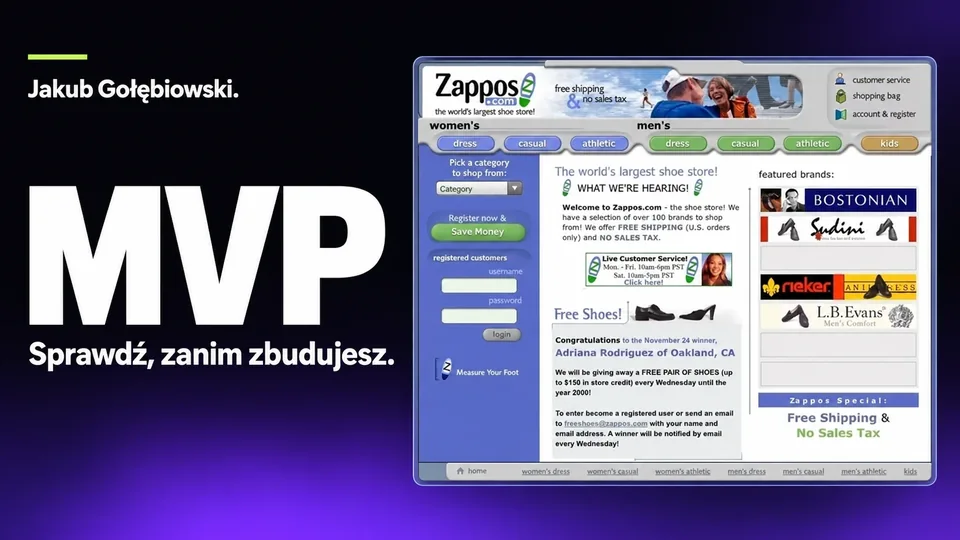
Zappos – the first digital MVP in history
Founder of Zappos, Nick Swinmurn, wanted to check whether people would buy shoes online. Instead of immediately investing in warehouses, logistics and technology, he did something simple:
He went to local shoe stores.
He took photos of the shoes.
He posted them on a simple website.
If someone placed an order, he went to the store himself, bought the shoes and sent them to the customer.
This is what the first version of Zappos looked like, when there was no stock or even a warehouse
At the beginning, he contributed a little to the business - the website, purchasing shoes, shipping. but it was hundreds of dollars, and he didn't need the entire warehouse for tens of thousands of dollars. It was pure MVP – the simplest possible version of the product that allowed us to test the most important business thesis: Will someone pay for shoes bought online?
He didn't build the technology until he was sure there was demand. Thanks to this, he saved money, verified the idea and obtained data needed for further development.
Dropbox
Instead of building the infrastructure, they recorded an explainer video with the prototype and checked if people would leave an email. Thanks to this, they gathered thousands of interested people even before the product was created.
Buffer
They created a landing page with a product description and a "select plan" button. Only when someone clicked did the message "not ready yet - leave your email" appear. Only then did they start construction.
Desire Lines
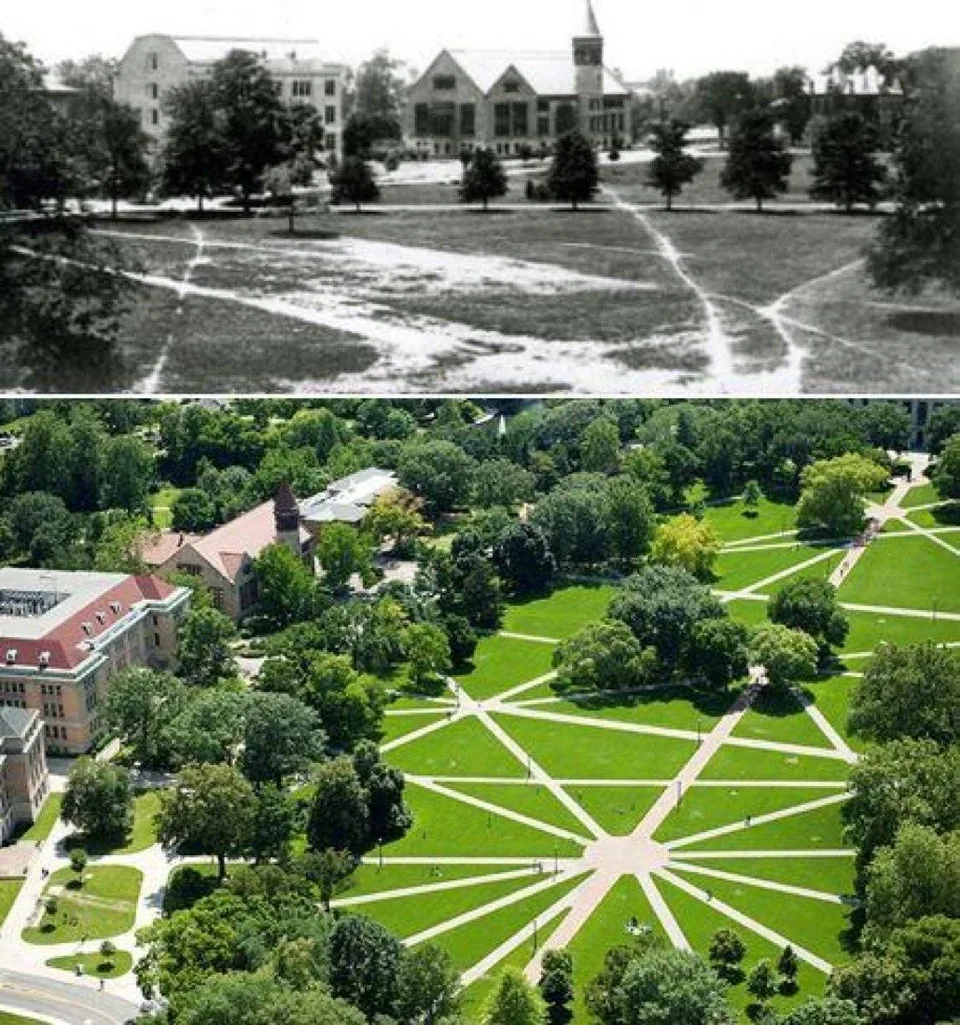
Designers of campuses, parks and urban spaces sometimes first sow grass and allow users to freely use the space, only then build formal passages along well-trodden paths that best meet the natural needs of pedestrian traffic.
This is MVP thinking applied to urban planning.
Examples include the University of California Davis, Dartmouth, and Michigan State University.
Video courses
A friend of mine who sells online courses takes them first…. he sells it and then records it. She can afford it because she's very good at it - she knows she'll deliver on her promise, but she won't sit in front of the camera until she's sure there are customers for it.
And how does she check if someone will buy her course? He makes trial landing pages, advertisements, and announces on social media.
In summary, MVP
MVP is a tool that allows you to minimize risk and better understand the market. This is not only a way to save money, but also to get closer to the real needs of customers. MVP is about one thing: check before you build everything.
FAQ: Frequently asked questions and doubts about MVP:
Does an MVP always have to be a product?
Not necessarily. Sometimes it can be a service, a landing page or even a demo that shows the idea. The idea is to verify the idea with minimal effort and costs.
How long should the MVP process take?
It depends on the industry and product, but generally the sooner the better. The goal is to test quickly and learn from mistakes.
What if MVP doesn't work out?
It's part of the process. That's why we create MVP - to find out what works before we invest more money. Each iteration is a step forward.