Developing brand positioning is the basis of any business. Without such a foundation, actions will be chaotic, often ineffective and sometimes even harmful.
In the article below you will learn:
🔹What is brand positioning and why is it one of the most important marketing and business tools? 🔹 How to develop your positioning and avoid mistakes?
🔹 How not to harm your brand with bad positioning?
🔹For the curious: Where did positioning come from?
🔹What is brand positioning?
Positioning is the creation of basic associations with the brand so that it takes the appropriate position in the customer's mind (hence the name). These first associations are the strongest and determine most purchase decisions - you may be surprised how few customers do precise analysis when shopping. And even if they do, they still decide on what they know and what fits their vision of the world. Something that has already taken a certain place in their head.
Do you want to buy a reliable car and your cold analysis shows that the best ones are made by a little-known company from India? You'll buy German anyway. It's obvious that German ones are reliable, right? Everyone knows it. Even though it may not be true.
In Poland we have a word for it that, in my opinion, fits perfectly - pigeonholing. Positioning is about being classified by customers in accordance with our business model, strategy and market potential.
I'll tell you a secret: if a brand doesn't have a positioning created, we start each campaign at Rek House by developing it. Without this, you can't count on good results.
How to do it? This is what the rest of the article is about.
🔹Why is positioning effective but also inevitable?
Positioning works because it is our lazy brain's way of simplifying information from the world. We categorize people, phenomena and products so that we can make decisions effortlessly later.
Let's tell a simple story:
You started taking nice photos as a passion. You showed them to your family and friends and they told their friends about it. At some point you started winning photography competitions, having exhibitions and paid orders. You have become the "photo guy" in your company. Way to go! You have just positioned yourself in their minds as a photographer!
What does this mean? If there is any problem related to photography, you are the first one that comes to mind.
If someone wants to buy a camera, they ask you for advice. Even if you have no idea about the differences and prices of cameras on the market.
If someone has anything they want to photograph, they ask for a quote. Even if you photograph completely different things.
If someone wants to start taking photos, they ask how to start. Even though you've never taught anyone.
Even if you stop taking photos, people will still ask you about them for a few years.
The above situations don't really make logical sense, but because people have pigeonholed you and associated you with a given trait, it's less effort for them to ask you questions than to look for someone new.
Why does this translate to brands? Because people treat brands the same way they treat other people. Our brain tries to look for familiar patterns everywhere, and what is the most familiar to the human brain? Man. That's why we often give human characteristics to animals and things. It's called personification and anthropomorphization.
The video below tells it well. To engage their audiences more closely, brands on social media started behaving like people: they talk about themselves in the first person, they are having a bad day, and sometimes they are even depressed.
To summarize: Just as we pigeonhole people in our heads, we do the same with brands.
Everyone had "the funny one", "the one always prepared", "the serious one" in class.
Similarly, everyone knows the brand "the reliable one", "the elegant one", "the cheap one".
Don't be afraid that your customers will pigeonhole you. They will do it anyway. It's important that they do it your way.
🔹Basics of brand positioning
Your brand can mean the world to you. But not necessarily for the world. Your customers devote their attention to other things: their own problems, interests, work, family, friends.
Therefore, your positioning should enter their minds quickly, nicely and pleasantly. When will this be the case? When it will be short, simple and accessible.
She told it perfectly in this interview Sophia Bendz and Christian Meerman - CMO responsible for the growth of brands such as Spotify and Zalando. Below is an excerpt, but I recommend reading the whole thing:Nail what your brand stands for: who are you and what role do you want to play in your users’ lives? Think seriously about what's your reason for being as a brand, what's the insight that took you there, who you want to present yourself as. Repeatedly ask yourselves this when you define your brand.
Get your 3 USPs straight once and forever: customers can have a hard time remembering too many Unique Selling Propositions. Zalando used 10 different USPs initially but those got diluted by missing consistency. They thus defined 3 core USPs and from that day onwards they were put on every single marketing product and ad exactly in the same wording, order, and so forth. This made everything more streamlined and consistent.
It's all about repeating: once you've identified your core messages, make sure you stay consistent throughout your communication channels and repeat the message. Repeat it all the time, everywhere. This makes it easier for current and desired users to remember who you are, what you stand for, and why they should choose your brand.“
To summarize: Focus on no more than three unique elements of your brand. Those that are most important to you, that distinguish you from the competition and that the market needs. And then communicate them over and over again.
Simple positioning process:
Research the market. Your positioning must be embedded in market realities, based on cultural contexts and customer needs.
Find your differentiator. Find what uniquely distinguishes you from the competition and create the main benefit for your customers.
Build credibility. Refine your company so that you can fully fulfill the promise of your positioning and be able to talk about it credibly.
Communicate positioning. Every element of your company should constantly and persistently communicate your differentiators.
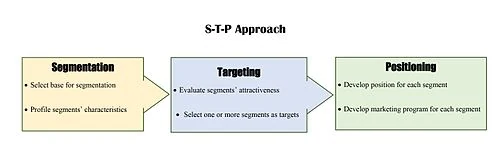
Another arrangement of its positioning activities is the S-T-P system. These letters stand for:
1. Segmentation: it is the process of dividing a broad market into small subgroups of consumers, i.e. segments
2. Targeting: selecting the segment or segments that will become our target market.
3. Positioning: Only now are we making the brand occupy a distinct position in the customer's mind compared to the competition.
🔹The biggest mistake when creating positioning
A common problem is that business owners do not want to limit themselves in their message because they are afraid of losing a certain segment of customers. This only means that they do not reach any segment better than the competition and they do not break through in any respect. If something is for everything, it is for nothing.
But it can be even worse - when several people have to decide about the positioning and every opinion has to be taken into account. When does this happen? When, for example, it is decided by a committee composed of directors of various departments. Then everyone adds information that is important to them and in the end everything blurs. When provided with such a dose of information, the customer will sooner become discouraged than arrange the company's positioning in his head.
🔹 How to find your unique positioning?
Your positioning should be based on the business model and unique features of your product or service. It is also worth making them consistent with cultural codes, the economic situation and customer needs. You often need to refine your product to make it more consistent with an attractive market niche and customer needs.
Adrenaline diapers? This probably won't sell. Diapers that are healthy and ecologically produced? Great.
Inspiration, and then look for unique features of your positioning:
▪️Price. Maybe you want to reach customers for whom a good price is important?
Example: Biedronka - low prices every day.
▪️Gender. Maybe your business is tailored specifically for a given gender?
Example: Ewa Chodakowska – trainer of all Polish women
▪️Origin. Maybe your product is unique because it comes from a specific place? Example: Japońskienoze.pl or Powiśle clinic.
▪️Benefits. Maybe your product offers a unique benefit?
Example: Danio fights Little Hunger.
▪️Target group. Maybe your clients have something unique in common?
Example: Media Markt - not for idiots.
▪️ Category. When your brand becomes the name of a product, get ready for profits.
Example: Adidas is a synonym for sports shoes, Pampers for diapers, and a bicycle (from the English brand Rover, which produced them before the war)... a bicycle.
▪️Tradition. Maybe you have been on the market for a long time or have a traditional recipe?
Example: Zielona Budka. Chosen for generations.
▪️Method of production. Maybe your product is produced in a unique way?
Example: Kujawski Oil. Discover the power of nature from virgin.
Once you've found the most important elements of your positioning, it's worth researching your competition. Sometimes a small change is enough to occupy an attractive niche.
Example:
BMW is a German, more expensive, sports car.
Mercedes is a German car, more expensive and elegant.
What does this one change cause? A young man looking for excitement will choose a BMW, while a mature man over 50 will feel great in a Mercedes showroom. Of course, this is a huge simplification, but it explains the idea well.
🔹 Sometimes non-obvious positioning is good positioning.
Don't be afraid to look for unusual but logical positioning. There may be more potential there than you think.
Old Spice.
The Old Spice brand has been operating since 1938 and was therefore perceived around the world as a brand for retirees. The company was looking for an idea how to get out of this positioning and in which direction to go. Research has shown that 60% of men's cosmetics are chosen by... women - for their men while making other purchases. How to use it?
If you think about it for a moment, it's quite obvious. The Wieden + Kennedy agency launched its famous campaign "The Man Your Man Could Smell Like". This repositioned the Old Spice brand from one for grandparents to one that women want their men to use. Because then their men will become like the man from the ad below. Maybe it's some twisted positioning, but it sounds appealing, right?
Effect? The campaign was launched in February 2010 and the goal was to increase sales of the body wash gel by 15%. By May 2010, sales of Old Spice Red Zone shower gel increased by 60% compared to the previous year, and by July 2010 they doubled. No matter how much money was put into advertising cosmetics for retirees, there would be no chance of achieving such results.
Red Bull
Who needs energy? Tired people. What are people most tired of? Handwork.
Therefore, it should not be surprising at all that Red Bull was created in the 1970s in Thailand as an energy drink called "Krating Daeng" (Red Buffalo) and was positioned as an excellent solution for manual workers in the provinces.
And it probably would have stayed that way if it weren't for Dietrich Mateschitz. It was an Austrian who tasted Krating Daeng on a trip to Thailand and decided to make money from it. He began importing the drink to Europe and changed the name from "Red Buffalo" to "Red Bull" (the bull is Mateschitz's zodiac sign). There was only one problem. There are not many Thai manual workers in the provinces in Europe and the brand positioning had to be developed anew.
Who in Europe needs more energy? Those who already have a lot of energy - young, active, partying! Red Bull followed this positioning, and its logo began to appear at the most energetic events and most extreme sports competitions. The brand's slogan perfectly sums it up - "Red Bull will give you wings."
Effect? Red Bull launched in Austria in 1987 and sold 1,000,000 cans that year. 10 years later he was selling that amount a day. In 2020, it was almost 7,900,000,000 cans - practically one for every person on Earth.
You can see the whole story in detail in the video below:
A good way to find non-standard positioning is the Blue Ocean Strategy, which I will talk about in another article.
🔹Why do you need to combine positioning and business model?
The answer is very simple: if your brand promises something, it should deliver it - and to deliver it in the best possible way, it must work 100% in accordance with the positioning.
Is it possible to position yourself inconsistently with your business model? You can, but such a situation is only a burden for the brand and frustration for customers. Customers then feel cognitive dissonance because their associations are inconsistent with the product they receive.
If your restaurant has elegant decor, waiters in suits and a live string quartet, you won't serve canned beans, right? With the setting itself, you promise your customers something completely different.
Let me ask you a simple question - what does Rolls-Royce produce? It is obvious that technologically refined, high-quality... aircraft and ship engines. For most of its time, the Rolls-Royce brand produced both luxury cars and industrial engines. Only then there was one problem - promoting one positioning weakened the other. It was only in 1998 that the car and engine departments were separated to avoid confusion. Currently Rolls-Royce Holdings produces engines, a Rolls-Royce Motor Cars cars.
To sum up: if your model is inconsistent with very attractive positioning, change... your business model.
🔹 How to enter markets that are inconsistent with your positioning?
If you see an attractive niche that is inconsistent with your current positioning, it is worth either repositioning yourself or creating a daughter brand.
We talked about repositioning during the Old Spice campaign, so let's focus on other solutions.
Mark - daughter
When Toyota wanted to enter the luxury car market in 1983, it created the Lexus brand - which is still produced in the same factories. Thanks to this, Toyota continues to be a reliable everyday brand in the minds of customers, and Lexus has taken over a large part of the premium market.
Brand purchase
You can also enter a new segment by purchasing an already positioned brand. In 2000, the Volkswagen Group fully bought out Skoda to take over the mid-lower class car segment. This allowed the Volkswagen brand not to be weakened and remain in the middle class. What is most interesting, currently Volkswagen and Skoda cars often have the same components (engines, brakes, etc.), and what differs the most is the way they are promoted.
Some companies even have brands that... fight each other. Thanks to this, no matter how customer tastes change, profits will remain the same.
Next to the Thaisty restaurant in Warsaw there is the Zdrowa Konkurencja restaurant. She is healthy, but is she really Competition? Both serve Asian food, both have similar prices and both have... the same owner. If you want to eat good quality Asian food near Plac Bankowy, your profits will end up in the same place anyway.

🔹 How not to harm your brand with bad positioning?
Can positioning be harmful?
Maybe, if you don't keep your finger on the pulse and don't react to changes in the world.
Let me give you an example of three brands that were powerhouses in their time but are struggling today: Harley-Davidson, Marshall amplifiers, and Gibson guitars. Each of these brands is associated with a culture based on rock music, which was a very attractive positioning from the late 1960s to the early 1990s. However, in the 1990s, the popularity of rock began to decline, and now it is a niche culture.
All these brands have become stuck in their positioning and have not moved with the times, which today prevents them from gaining new customers.
Harley-Davidson
Harley is synonymous with a heavy, classic motorcycle for rock rebels. While for our parents' generation it was a desired symbol of freedom, today's generations prefer scooters and electric bikes. There was a time when riding a Harley to the hottest music festival was the height of fashion. Today, someone would rather travel by camper or by train.
Effect?
In 1987, the average age of a Harley rider was 35, and around 2010 it was approaching 50. I haven't found current data for 2021, but rather the average has increased significantly, perhaps already into the 60s.
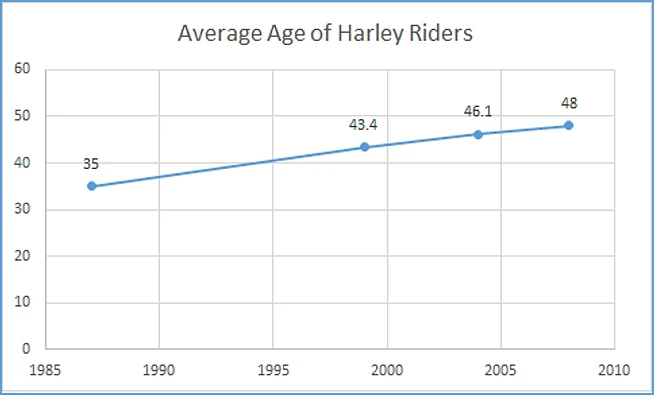
Harley-Davidson did not timely begin to reposition its brand and offer products in line with the times. He did not change according to the world and did not prepare the world for such a change. This radicalized his fans and alienated him from younger generations.
At this point, any attempt to go beyond its positioning is met with hate (like the introduction of the electric Hardwire model) or at least with extreme opinions (like the radical redesign of the Sportster model for the first time since 1957(!)). Harley-Davidson sales are skyrocketing and I'm very curious how the brand will defend itself in the future. Some say that being the CEO of this brand today is the most difficult job in the world.
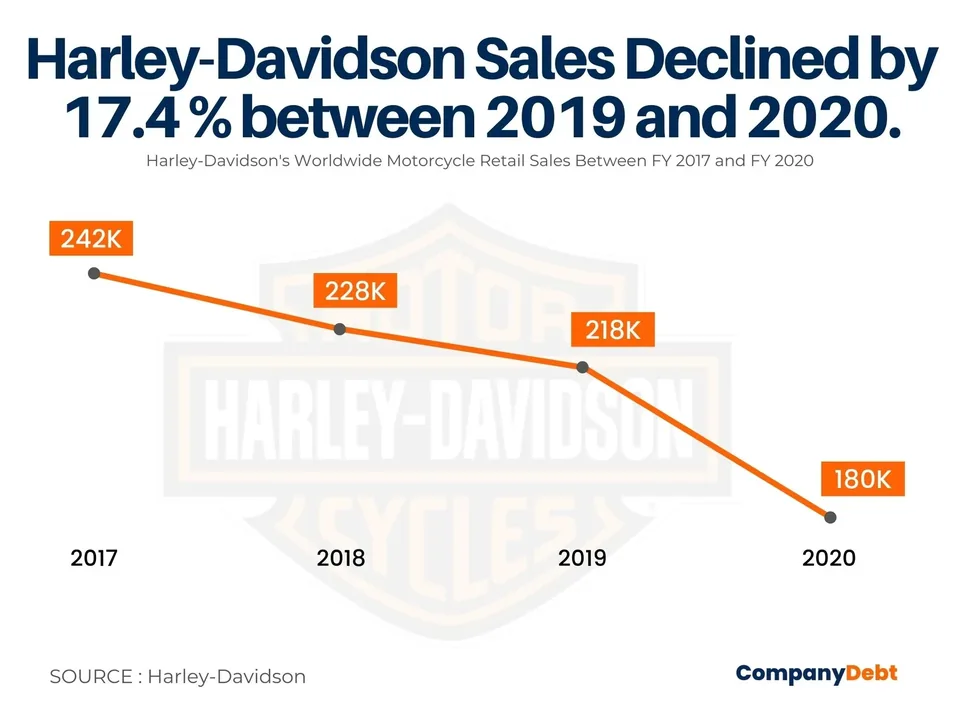
Details about the situation of the Harley-Davidson brand can be found in the video below:
You can do it differently: There is a very similarly positioned brand of American motorcycles - Indian, which was created two years before Harley-Davidson. However, the Indian brand went bankrupt in 1967, but was revived in 2006, and in 2011 it was purchased by Polaris Inc. - a large manufacturer of snowmobiles, quads and other motor vehicles. Polaris has gathered a strong production base, great engineers and a classic brand in one place - what to do with it?
Of course, start all over again. As their positioning says, written in the very center of the website: A NEW GENERATION OF CHIEF IS BORN.
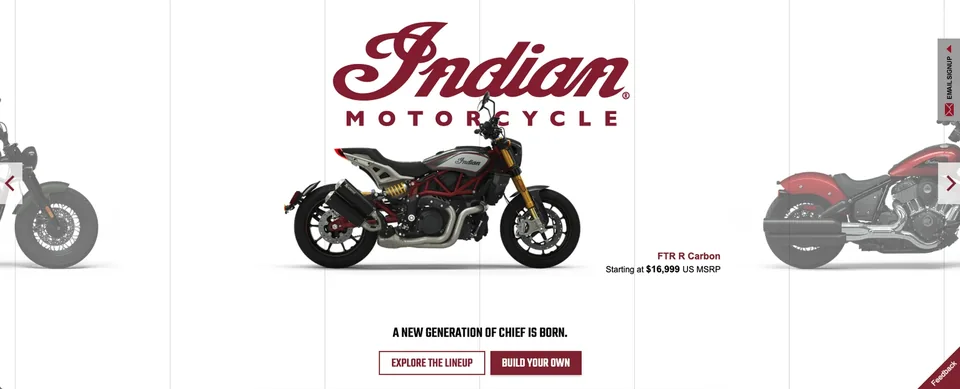
Instead of positioning itself as an old brand with traditions, Polaris began to position the Indian brand as one that had always been ahead of the competition with innovative solutions.
Thanks to this, Indian can use both design that refers to classic motorcycles, as well as the most modern technical solutions. In this way, it became a modern Harley-Davidson, which is what Harley-Davidson should have been striving for 40 years ago.
Marshall amplifiers and Gibson guitars
These brands have such a similar situation and operate in such similar industries that I decided to discuss them at the same time. Moreover, they create a connection - a Gibson guitar combined with a Marshall amplifier is the basis of the sound of almost every rock band from the 1980s. In the case of both these brands, the problem is the same - they were unrivaled in their segment, but this segment is now in regression.
Gibson guitars gained popularity from the 1950s to their peak in the 1980s. However, the company created its last new guitar designs that became a permanent part of its offer in 1958 (Explorer and Flying V). Since then, it has tried to introduce innovations, such as self-tuning guitars (Robot) or those enhanced with electronics (Firebird X), but none of them caught on. Guitarists are quite a conservative group, and Gibson fans are among the leaders in this respect. This couldn't end well.
On May 1, 2018, Gibson filed for bankruptcy with the possibility of concluding a restructuring agreement.
However, the electric guitar is not everything. The amplifier is an important element of sound.
A wall of Marshall amplifiers was an integral part of a rock or metal concert. Thanks to such promotion, the brand became inextricably linked with this culture and everyone bought them: both professional musicians and beginner kids to play in the garage.

A Marshall amplifier produces its best sound when the volume is turned all the way up. This is where slogans like "If it's too loud, you're too old" and the band's competition to see who will play the loudest concert come from. Marshall = Loudness. If you're playing at home on Marshall, the whole neighborhood should be at the show. Easy.
What does it look like in practice? See below:
Today, however, the sound of a guitar can be created digitally and it is no longer even the future, but the present. I play concerts myself by plugging my guitar into my iPhone. Currently, the largest group of guitarists are the so-called Bedroom Guitarists - people who create music, practice and record in their room, usually an apartment. They do not look to Marshall for solutions because it clearly positions itself with a large, loud amplifier. The brand is trying to compensate for this by releasing beer, mobile speakers, glasses, headphones, jukeboxes and even refrigerators. Marshall is also trying to produce new types of amplifiers, but its customers still have the vision of this brand from the 1980s in their heads. For modern, professional musicians, this positioning is also not attractive - Marshall is associated with the music of oldies and boomers, and for millennials it is an embarrassment. That's why modern guitarists usually use equipment from other brands, as you can read about below.
You can do it differently: Even though the market for guitars and everything related to them is going through a recession, the Fender brand is still going strong and is visible on the most fashionable stages in the world. It is a brand of universal guitars and amplifiers - good for everything, but never limiting its positioning to a given style. Fender even had a period where it tried to take over some of Gibson's market, but quickly got over it. It remains a universal guitar - for blues, rock, funk, and most importantly, also pop. Styles change, Fender adapts. It attracts customers not only with sentiment, but also with current fashion.
Thanks to this, the brand can produce classic guitars, but also ukuleles with Billie Eilish's signature, digital solutions, innovative guitars and still remain consistent with its positioning.
To summarize:
Brand positioning is like species in nature. A narrow specialization can give you a huge advantage in the right environment, but if you are not ready for changes, you can quickly die out.
🔹For the curious: Where did positioning come from?
Jack Trout and Al Ries are considered the fathers of the modern understanding of positioning.
They used the term "positioning" in 1969 in the article "Positioning is a game people play in today's me-too market place" in Industrial Marketing magazine. They then fully developed this idea in their 1981 book “Positioning: The Battle for Your Mind“, which remains the industry standard to this day.
In fact, the origins of the idea of positioning are unclear, but certainly much earlier.
Some researchers attribute the authorship of this idea to Mr. David Ogilvy in the 1950s, at least a decade before Ries and Trout published a series of articles. Even Messrs. Riesi Trout in their early articles suggest that the concept of positioning was widely used in the advertising industry before the 1950s.
Ogilvy's surviving notes indicate that he was well aware of this concept and had been training his creative team with the idea since at least the 1950s.
A few quotes from his notes: - "The most important decision is how to position your product" - "each advertising is part of a long-term investment in the brand's personality."
Ogilvy used the positioning concept in several campaigns in the mid-1950s and early 1960s
He explained his 1957 campaign for Dove: "I could have positioned Dove as a soap for men with dirty hands, but instead I chose to position it as a toilet bar for women with dry skin. And it's been working for 25 years." He described his other campaign, this time in 1961:
"In Norway, the SAAB did not have a specific profile. We decided to position it as a winter car. Three years later, it was voted the best car for Norwegian winters"
However, there are traces that position the positioning even earlier. Around 1920, the American agency J. Walter Thompson was already working on things like brand personality, brand image and brand identity - after all, these concepts are very closely related to positioning.
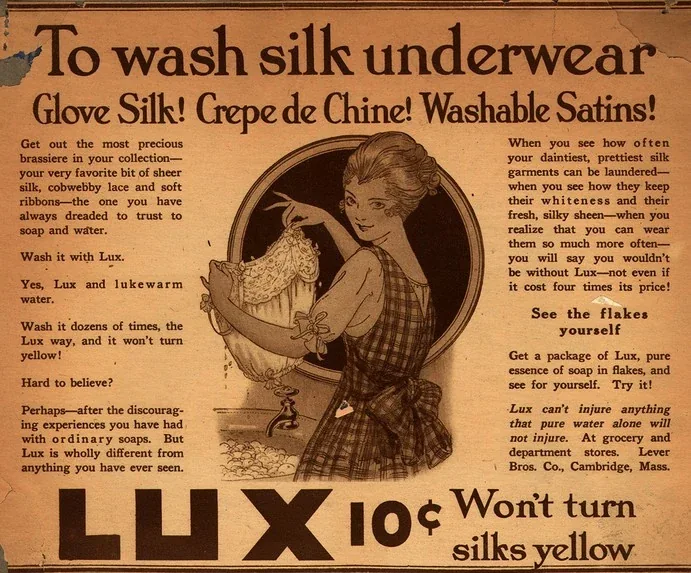
For example, in 1915, J. Walter Thompson began promoting Lux soap. The agency suggested that the traditional positioning of soap should be broadened from a "product for woolen clothing" to a soap for use on all delicate household fabrics.
To achieve this the soap, Lux has been repositioned. The agency cut the brand off from ads depicting homework in favor of those presenting an exclusive lifestyle, expensive clothing and fashion, and free time.
This demonstrates a full understanding of how consumers create a brand position in their minds - using perfectly matched cultural codes.
What is my opinion on this? As with any marketing technique, I personally wouldn't be surprised if a merchant in ancient Rome or Greece came up with it. Authorship of a technique or idea is often attributed to the person who promoted it rather than invented it.
Even though Mr. Jack Trout probably didn't invent SEO, I recommend his excellent talk on the subject:
🔹Sources:
Harley-Davidson:
https://www.reuters.com/article/us-harleydavidson-boomers-analysis-idUSBRE95K0GU20130621
https://sherpablog.marketingsherpa.com/consumer-marketing/harley-davidson-new-customers/
Indians
https://chiefmarketer.com/a-ride-with-indian-motorcycles-marketing-strategy/
https://www.forbes.com/sites/jenniferrooney/2018/05/01/cmo-qa-indian-motorcycles-ride-to-renewed-relevance/?sh=1ddb6c467076 Gibson https://medium.com/on-human-centric-systems/gibsons-bankruptcy-is-a-cautionary-tale-about-corporate-innovation-bba75442d167
https://www.strategie-aims.com/events/conferences/29-xxviieme-conference-de-l-aims/communications/5079-gibson-vs-fender-innovation-paths-in-the-early-electric-guitar-industry-19451984/download Marshall https://racingtoaredlight.com/post/190912820763/marshall-amps