
Every day you see successful people and it makes you falsely judge the world.
Influencers with a luxurious life. Startups sold for millions. Famous musicians. Bestselling authors. Athletes with medals. Entrepreneurs talking about the "winner's mindset".
The problem is that you almost never see those who didn't make it.
And there are definitely more of them.
This is the survival error (survivorship bias) — one of the most insidious cognitive biases that causes us to overestimate the chances of success, ignore the risk of failure, and make very harmful decisions.
What is survivorship bias?
In short: we judge the world through the prism of those who succeeded (hence the "survivability" in the name) and ignore those who failed.
This is a form of biased example selection, which can lead to overly optimistic beliefs, wrong decisions and harm.
What are the consequences of survivorship bias?
You spend years paying off your hyperoptimism
If you start to believe that success is virtually guaranteed and you begin to act on that logic, you can bring great harm to yourself.
People due to survivability bug:
they take absurd risks,
they overestimate their chances,
they ignore statistics.
Because of this:
they take excessive risks
they abandon stable lives under the influence of media illusions,
they go into debt,
they do not protect themselves against failure.
And as a result:
they spend years paying off the mistakes resulting from hyperoptimism.
Instead of real history, you see fantasy
The insidious thing is that when someone succeeds, it is very easy to start believing that the success was solely the result of intelligence, strategy, mindset or discipline.
People love to build stories to explain success. The problem is that very similar characteristics also had thousands of people who completely failed.
You just don't see them because they have disappeared from the market.
Economists and psychologists have repeatedly emphasized that the following also play a huge role in success:
happiness,
timing,
environment,
coincidence.
From my experience, there are also things that no one talks about publicly, because it is much less common to talk about:
exploitation of people,
destroying competition,
manipulation,
breaking the law,
psychopathic personality traits,
obsession at the expense of health and relationships.
Some successful people are truly outstanding. But some were simply willing to do things that others were not willing to do.
You don't enjoy life
Another problem is that people don't appreciate what they have.
The problem is that you only overestimate your chances of success, but at the same time you start to despise normal life.
You may start to think that an ordinary, stable life is worthless because all you see is great success everywhere.
Sources:
Social media amplifies the problem dramatically
Instagram, TikTok and YouTube are an ideal environment for survivorship bias. Some even call these media the Pornography of Success.
Algorithms promote:
success,
wealth,
luxury,
spectacular results,
people "who won".
They do not promote:
mediocrity,
failures,
bankruptcies,
mentally burnt out people,
those who tried and failed.
As a result, a person scrolling through social media begins to feel that:
everyone earns a lot of money,
everyone is doing business,
everyone invests,
everyone is successful.
This is a completely false picture of reality.
Sources:
Now here are some examples:
In music, the winner takes it all
Pop culture only tells the stories of those who succeeded. Because would you like to watch a movie about a band that released their first album, no one listened to them, broke up and then went to work?
Now, in this context, imagine a boy who dreams of a musical career.
He sees stars everywhere:
on Spotify,
on social media,
at concerts,
in interviews,
in podcasts.
However, he does not see thousands of people who:
they recorded music,
they invested years of their lives,
and after a few years they gave up.
And this is where specific data comes in.
According to music market analyses:
about 90% of music on Spotify has a very small reach,
a small percentage of artists generates the majority of listens,
less than 1-2% of artists reach a level that allows them to make a living solely from music.
Sources:
More actors end up behind bars than with Oscar
Every year:
thousands of people go to LA to become actors,
they see stars,
red carpets,
Oscars.
But most end up:
working in gastronomy,
with debts,
after years of frustration.
And almost no one makes films about them. This is survivorship bias in its purest form.
Startups usually fail
The survivorship bias is particularly visible in business.
Success distorts our perception of reality because we ignore all the companies and people who failed.
In the media you see:
startups sold for millions,
founders at conferences,
"from garage to billions" stories.
You don't see companies that:
they finished after a year,
never gained customers,
they burned through investors' money,
they closed their operations quietly.
Meanwhile, the data is brutal. According to CB Insights analyses:
approximately 70% of startups fail between the 2nd and 5th year of operation,
approximately 90% of startups ultimately fail.
Source:
Most books no one reads
The book market works exactly the same way.
You see:
bestselling authors,
people on top sales lists,
interviews with writers,
huge publishing successes.
You don't see:
thousands of rejected manuscripts,
books selling dozens of copies,
authors who gave up after years.
According to industry data:
most books sell very small editions,
only a small percentage of authors make a living solely from writing.
Sources:
Investing and the stock market are a great illusion of success
Survivorship bias is also a huge problem in finance.
When you look at the historical performance of mutual funds, you often only see funds that are still in existence.
What about those that:
had disastrous results,
have been closed,
went bankrupt,
were they combined with other funds?
They disappear from the statistics.
This makes average investing results look much better than they really were.
Financial research shows that ignoring closed-end funds can significantly overstate historical returns.
Sources:
Does that mean it's not worth trying?
No.
The point of this article is not to be afraid of action. The point is to look at the world more realistically and not to be sold a false image of reality.
It's worth having ambition, trying, taking risks. But it's not worth doing it stupidly and remembering that
success is rarer than it looks on the internet,
failures are hidden,
statistics are more brutal than motivational narratives.
That's why it's good to mentally visit the "graveyard of losers" sometimes. Analyze:
bankrupt companies,
unsuccessful careers,
wrong strategies,
bankrupts,
projects that “had it all.”
Not to lose motivation. To regain contact with reality and not to hurt myself.
Remember that the fight for success is similar to riding a motorcycle: the most important thing is to be able to fall without causing permanent harm to yourself, and then keep riding. But if you only see positive possibilities, you won't even wear a helmet.
Most people won't win, so learn to take risks so that you can survive failure.
Interesting fact: leaky planes from World War II
The most famous example of survivorship bias comes from World War II.
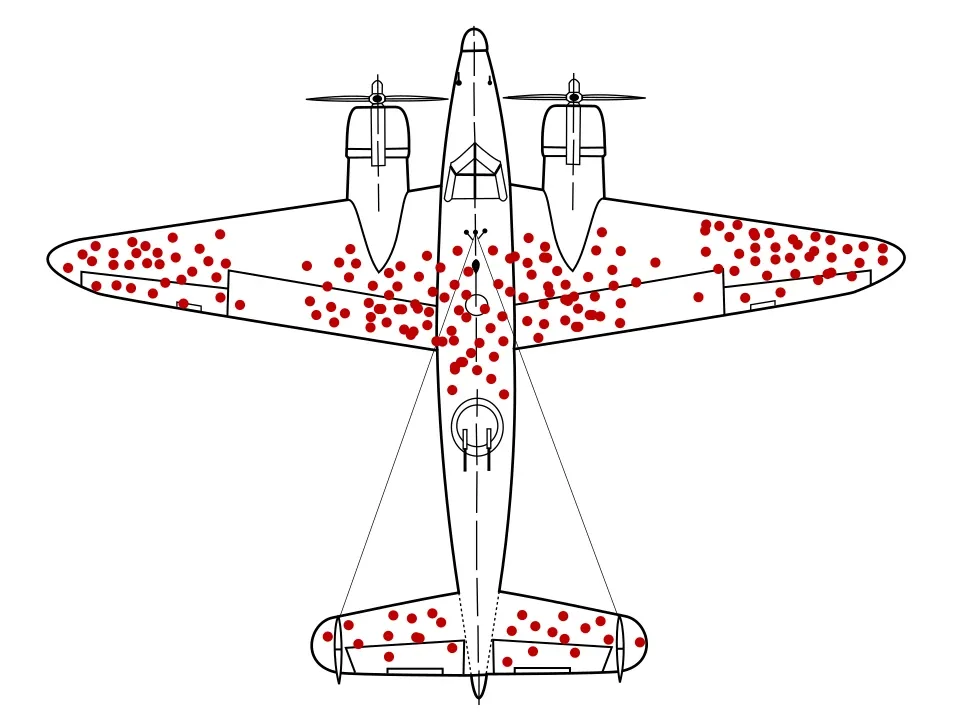
The American army analyzed planes returning from combat missions. There were lots of bullet holes in the wings and fuselage. So the military wanted to armor these places. Logical, right? Well, no, because if the army reinforced those areas that were most frequently hit, it would be a classic example of survivability error
Statistician Abraham Wald noticed something crucial: only planes that returned were analyzed.
This means that the hits visible on these machines were those of the plane could survive.
The most dangerous places were those without holes - because planes hit there never returned.
The following breakdown of damage to aircraft that returned from a mission shows where the aircraft could have been hit and still returned to base safely. And it was the place WITHOUT dots that needed to be strengthened.
Source: