What is UVP, or Unique Value Proposition?
In a saturated market, only those who stand out will survive. How to do it? There is a proven tool called UVP - Unique Value Proposition
From the article below you will learn:
🔹 What is UVP/USP* and why is it important?
🔹 How to develop your UVP?
🔹 What are some examples of good and bad UVP?
🔹 How to use UVP?
🔹 What is the difference between UVP and positioning?
🔹 *UVP vs USP or maybe UVP is USP?
🔹 For those curious: Where did UVP come from?
🔹 What is UVP/USP* and why is it important?
UVP is one of the most important tools needed in every company. This is not only the foundation of effective marketing, but also of a profitable business model. The name UVP is an abbreviation of the English Unique Value Proposition - which in Polish means Unique Value Proposition. These are precisely developed and communicated features that distinguish your brand. Translating in one sentence:
UVP is a unique set of customer-valuable features of your brand that no one else offers on the market.
UVP is a much stronger growth tool for a brand than the most creative marketing campaigns - because it is thanks to it that customers will choose you in a saturated market. According to Millward Brown research, over 10 years:
with a similar scope of activities and marketing budget, brands with strong UVP grew by 168%, while those with weak UVP only grew by 27%.
brands with poor marketing activities still grew by 76% if they had good UVP
🔹 How to develop your UVP?
Before we look for the unique features of your product, let's first explain what value is. Is the value for the customer a specific product function? It may be, but not necessarily. It may be the surroundings, social perception, climate. Diamonds in a ring are no more functional than any other stone, and a Rolex shows the same time as every other watch in the world - yet both of these products sell very well.
Therefore, when designing your brand's Unique Value Proposition, do not forget that your potential customers are... people. Customers often make irrational purchasing decisions and value irrational things - even if they don't admit it. Dan Ariely, a specialist in psychology and behavioral economics, begins most lectures with the phrase "today I will tell you about mistakes that everyone makes, but of course not you." Therefore, when looking for unique values of your brand, do not forget about soft features: emotional, social, prestigious, snobbery, sheepishness. Who knows, maybe they will be the distinguishing feature of your brand?
Now that we've explained this, let's start looking for your UVP, preferably step by step.
1. Determine your target market. Before you start looking for UVP, thoroughly research and get to know your potential customers first. Write down who buys your products, who doesn't buy, and who could buy. The more precisely you define these groups, the better. If you try to make something for everyone, you'll probably end up making something that no one really wants or needs. Nowadays, it's better to have 100 devoted customers than 1,000 who will quickly forget about you. Don't try to please everyone, but try to please a specific group the best in the market. Focusing on the needs of a specific group of people and meeting them in the best way possible in the market is the essence of UVP. Once you find a group of people you want to help, you will start to notice their real problems much more easily.
2. Determine what sets you apart from the competition. No matter how innovative your business is, it certainly already has competition, and it doesn't have to be a specific company. Because your customers already meet their needs, right? Netflix's competition is HBO Max and Amazon Prime, but also traditional cinema - this is also how you can watch a movie. Spotify's competition is Tidal and iMusic, but also vinyl records - this is also how you can listen to music. The competition for hotels are other hotels, but also Airbnb and Booking.com and even campers. The outstanding British economist, Lionel Robbins, created a classic definition of economics:
“Economics is the science that studies ways of using scarce resources that also have alternative uses.”
Your customer has a limited amount of money they are willing to spend to meet their needs - they won't buy all of the options. Now think - why should he reject other options for using his money and spend it with you? Create a specific list of arguments that will convince him. Just saying you're "better" won't get you very far. At this stage, watch out for a phenomenon called the Curse of Knowledge! Your opinion is the least important in all this. You make a product for your customers, not for yourself. Just because something is important to you, doesn't mean it is important to your customers. Don't project your tastes and opinions onto them. You can not like sweets and still run a thriving confectionery shop, right?
3. Recognize the problem your brand solves. Once you've clearly defined your market and your brand's unique values, it's time to consider how this translates into solving your customers' problems. Again, it is worth being very specific and not taking shortcuts - simple and clichéd "we make life easier", "we save time and money", etc. lead nowhere. We look for unique ways to solve problems - ones that your competitors don't provide. Remember to think more broadly again, not only in terms of "hard" and rational problems. For example: a Casio watch and a Rolex watch show the time in the same way, but Rolex solves the problem of presenting its status.
4. Consider what values your brand is built on. A Unique Value Proposition may not only be a function or a solution to a problem, but also values. Example: eco-leather shoes do not require killing animals for production, which for many customers is a Unique Value that will influence their purchasing decision. So, based on the previous steps, try to find values that you can add to your brand and that are attractive to your customers.
5. Try the Blue Ocean Strategy. This is an idea promoted by W. Chan Kim and Renée Mauborgne in 2005. It involves looking at the market and customer needs from a fresh perspective and outside the industry bubble (the above-mentioned curse of knowledge!), and then proposing a completely new solution. To put it bluntly - industry standards oil. Choose a few features of your product, refine them more than the industry, and ignore the rest. Below you will find a chart of the value of Yellow Tail wine, which has perfectly found its niche between cheap and expensive, prestigious wines. It turned out that there are a lot of Sunday wine lovers who want an easy-to-select and easy-to-drink average wine - they don't appreciate the whole surroundings of wine culture, but they don't want the cheapest product on the shelf. Yellow Tail brand UVP = no burden of wine snobbery + easy to choose and drink for Sunday wine drinkers + no embarrassment of cheap, low-end wine.
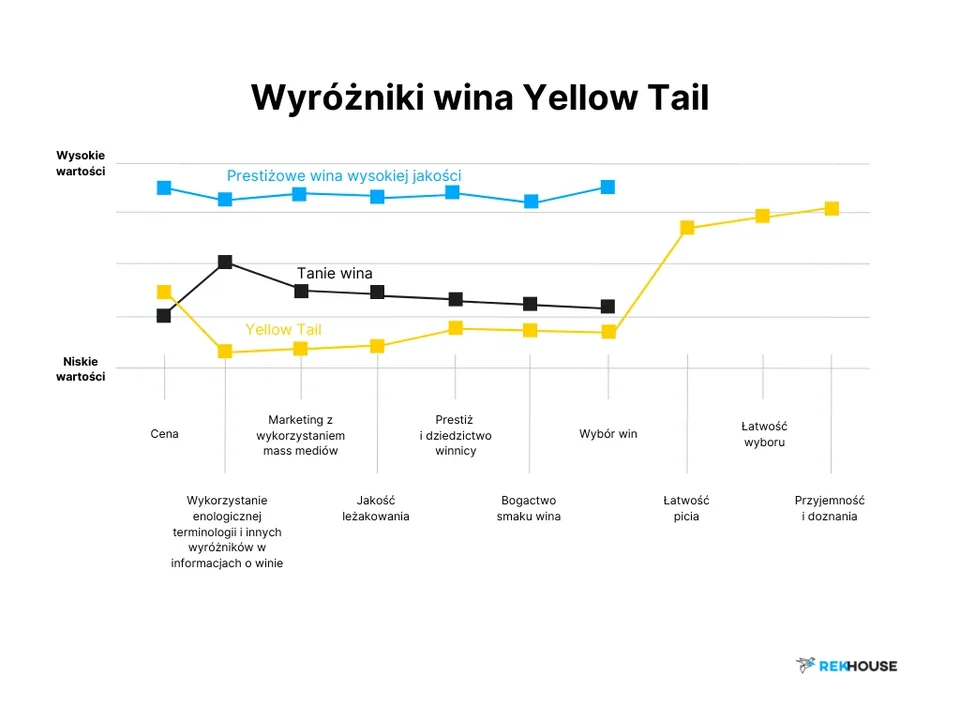
6. Or maybe the competition isn't talking about something? UVP/USP doesn't have to be something your competitor can't do - it may just be something they aren't vocal about.
7. Try, test and don't give up. Creating a Unique Value Proposition will probably take you several different attempts and a lot of time. What's more - if your brand will develop for many years, which I sincerely hope it does, it will have to adapt to the changing world - and remodel its UVP. There is one more important thing - don't trust surveys too much. My Behavioral Economics lecturer often said that a true economic experiment can only take place in the real world. In other words - it's one thing to say that you will buy something, and another thing to actually spend your limited money on it that has an alternative use. Therefore, it is worth being skeptical about the declarations of potential customers. An example is the game Prison Simulator, which recorded 188,000 on the Steam Outstanding wishlist. registrations of willing customers, and the real number of purchases from wishlists is only 9.1 thousand. pieces. This amounts to only 4.78% conversion among customers who were already deep in the sales funnels! Therefore, your UVP only when confronted with the real market will provide real data on how it defends itself and what your customers really think and feel.
🔹 What are some examples of good and bad UVP?
The biggest mistake when creating UVP is resorting to platitudes. The following texts have no value in terms of building your brand:
Our products are of the highest quality
We have services tailored to customer needs
We focus on comprehensive service
We are an innovative company
Any company can say this about itself, so what's special about it? By using such tired phrases, you are doing yourself a disservice because you are wasting one of your customer's most important resources - his attention. So in this case, what are good examples of UVP?
IKEA. The brand's mission is to offer a wide range of well-designed, functional home furnishing items at prices so low that as many people as possible can afford them. This slogan sums it up: We want to create a better everyday life for many people.
UVP IKEA =
1. good design
2. functionality
3. price available to a wide range of customers.
It must be admitted that they have it perfected in each product.
Frugo. On the one hand, it is just a juice, and on the other: a drink for teenagers symbolizing a break with everything old. Today it may seem obvious, but in Poland in the 1990s, Frugo's UVP, positioning and marketing were an absolute revolution. Here we have full focus on one customer niche, UVP in the form of social values, and even the Blue Ocean Strategy. When the entire juice industry focused on taste, quality and health values for the whole family, Frugo's marketing does not include anything like that. This led to a situation where the store had fruit juices and Frugo. Nobody bought Frugo because it was fruit juice, they bought Frugo because it was Frugo. No teenager said "Mom, take me some fruit juice, maybe Frugo" but "Mom, take me Frugo!"
UVP Frugo =
1. a rebellious and revolutionary break with everything old
2. product setting that distinguishes a specific target group
3. non-obvious flavor combinations
🔹 How to use UVP?
Once you've established your UVPs, it's time to narrow them down to the three most important ones. Christian Meerman, the man responsible for the success of Zalando and Spotify, summed it up perfectly:
“At Zalando, we experienced absolute chaos at the beginning - what to put in our advertising materials as our UVPs? Some members of the marketing team liked certain UVPs more than others, and quickly a set of around 10 different UVPs was created.
However, we saw that customers would not remember as many UVPs and our marketing was blurred due to lack of consistency. So we defined our three core UVPs, and from that day forward they were included on every marketing piece and ad in exactly the same wording, order, etc. This consistency streamlined everything and ultimately strengthened our consumer value proposition.
I encourage you to define your three UVPs early on, implement them without compromise, and repeat them everywhere, all the time. And yes, only three. No customer remembers more.”
And what to do when you already have your three selected and proven UVPs? Repeat without remorse. As Sophia Bendz said:
“Once you have identified the core three UVPs, make sure you are consistent across all communication channels and repeat them. Repeat all the time. And repeat everywhere.
Your UVPs should be in your terms and conditions, across all social media channels, in marketing campaigns, in press releases, in business interviews, in founder tweets, in offline and homepage activation marketing, in notifications and newsletter, etc. Communicate them simply, often and consistently. This makes it easier for existing and desired customers to remember who you are, what you stand for and why they should choose your brand.“
What else is worth adding? I guess just a few examples:
Home page of the website - Place UVP front and center on your site's homepage and metadata. Metadata is a short description that explains the content of your page. This will make it easier for customers to find you in social search engines. This is part of what is called SEO.
Social media – use your UVP on all social media profiles: both in the description and in posts, advertisements, photos, videos.
In print – use UVP on all printed materials such as brochures, leaflets, advertisements, folders.
PR and communications — try to smuggle in your UVP with every public statement.
Team – make sure that your company's staff, especially sales and customer service, are familiar with UVP and incorporate it into their work.
🔹 What is the difference between UVP and positioning?
UVP and SEO are used and understood differently – and sometimes wrongly perceived as interchangeable. But nothing could be further from the truth. These are two separate tools that complement each other perfectly.
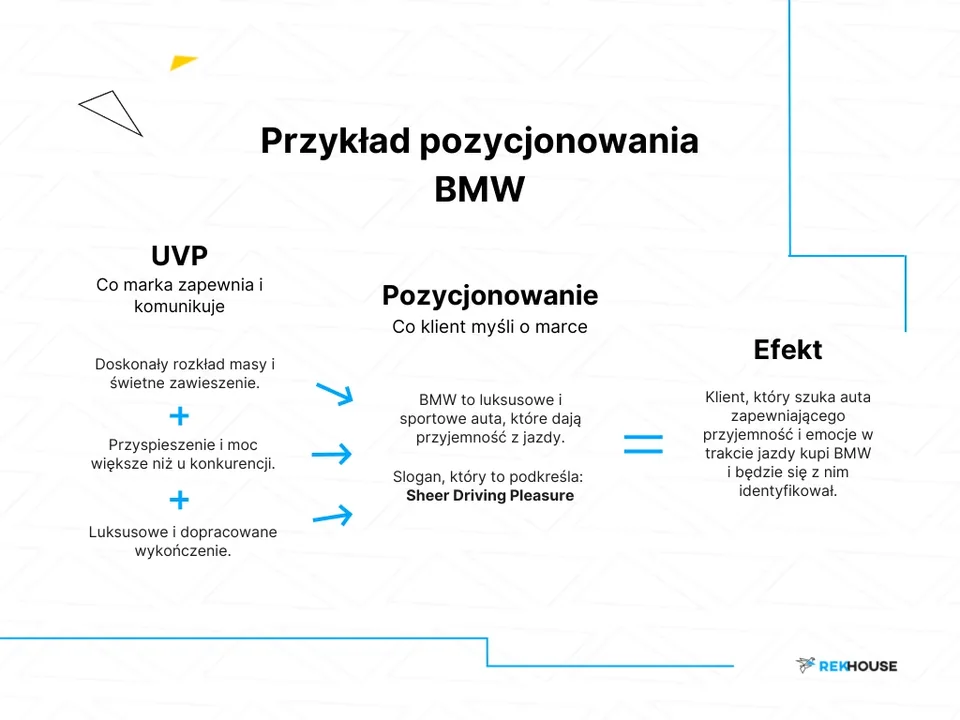
A unique value proposition these are specific benefits: financial, functional, emotional, etc. that distinguish your brand from the competition. UVP is what you say about your brand. It is the answer to the question: what will I do for the client that no one else can?
UVP example for BMW:
- excellent weight distribution and great suspension
- acceleration and power greater than those of the competition
- luxurious and refined finish
Positioning it is the labeling that the customer has in his mind about your brand. In other words: it is the opinion that the customer has formed about the brand. It is built with UVP that you can offer.
To explain this better, let's describe Spotify in a little more detail:
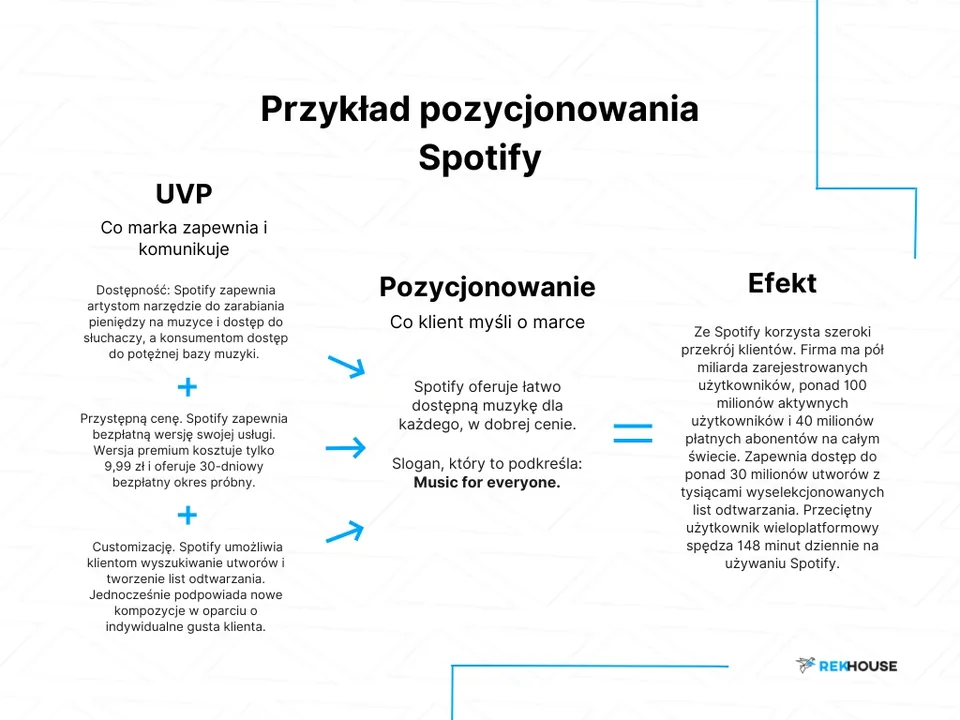
Summary: UVP are the building blocks from which the client builds positioning in his head. Then, based on positioning, it makes purchasing decisions.
I write much more about positioning here: www.rekhouse.pl/post/pozycjonowanie-marki
🔹 *UVP vs USP, or maybe UVP is USP?
Typically, in the marketing literature, there is often a separation of these two definitions, but this separation is not precise. Most often it looks like this:
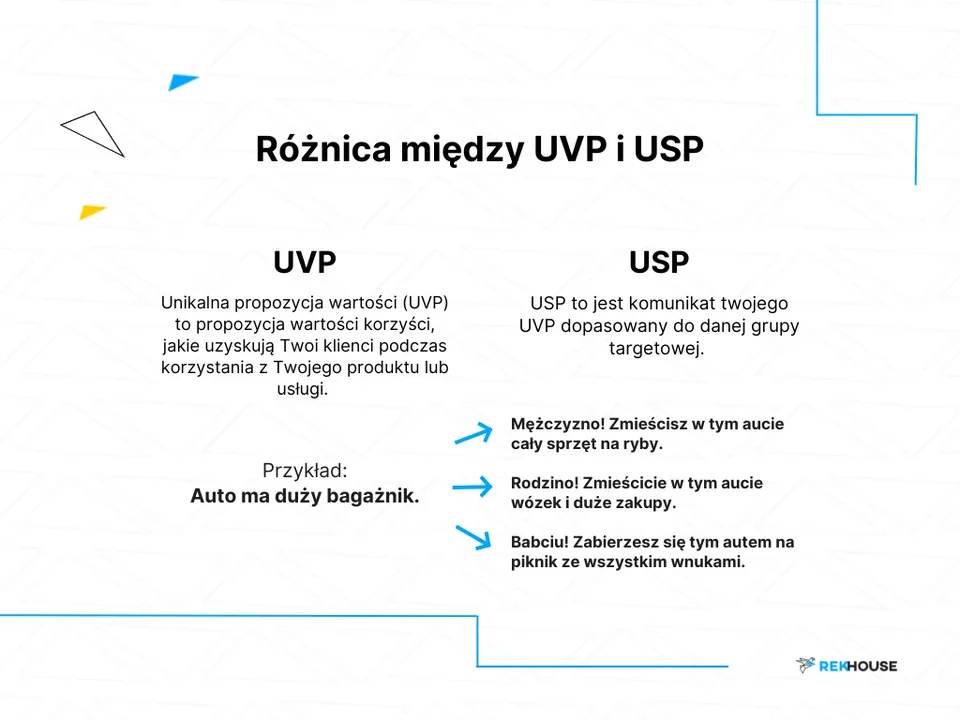
Personally, I am a supporter of combining these two concepts into one. Why? For powerful, international brands, separation may make sense, but for smaller ones, good refinement and communication of the UVP is already enough work - and often enough for development. That's why I recommend thinking of them as one. Usually, the need to distinguish UVP and USP means that your brand has developed so much that a team of specialists is probably working on it and they will take on this burden. And you will have completely different problems to deal with.
🔹 For those curious: Where did UVP come from?
UVP was used in successful advertising campaigns as early as the early 1940s. The term was coined by television advertising pioneer Rosser Reeves of Ted Bates & Company.
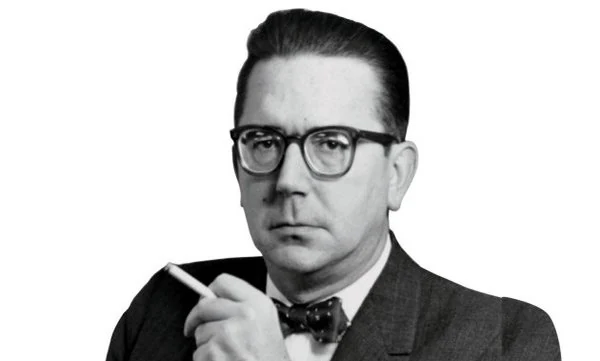
It was quite an interesting character. He was born in Virginia, the son of a Methodist preacher, and briefly attended the University of Virginia until he was expelled for a car accident - he was under the influence of alcohol, and it was during Prohibition. Fortunately, he then won a hundred dollars as a prize in a statewide chemistry competition. While other students wrote novel chemical formulas as their submission, Reeves wrote the inspiring essay "Better Living Through Chemistry." This was because he knew little about chemistry, as his study consisted mainly of drinking, dancing and gambling.
The hundred dollars he won was enough to move him to Richmond, where he was employed at a new bank. While working, it turned out that he was a poor accountant, but a very verbal marketer - that's why he started writing advertisements. He soon moved to New York to co-found Ted Bates & Co with Ted Bates, an advertising agency that grew to be the 4th largest in the world.
There he developed his idea of UVP - a clear development and presentation of reasons why the consumer should buy the advertised product. This perceived or actual benefit usually relates to a specific property that other products do not have or lack. As part of his work for the upstate New York advertising agency Ted Bates & Co, Reeves repeatedly tried to find and implement UVP for his clients. One of them even became president of the USA.
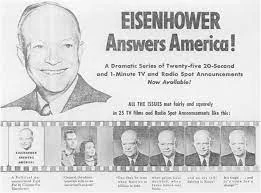
During the 1952 election campaign, Rosser Reeves implemented UVP to promote Dwight D. Eisenhower. Rosser could be brazen - he sold a candidate the way soap was sold.
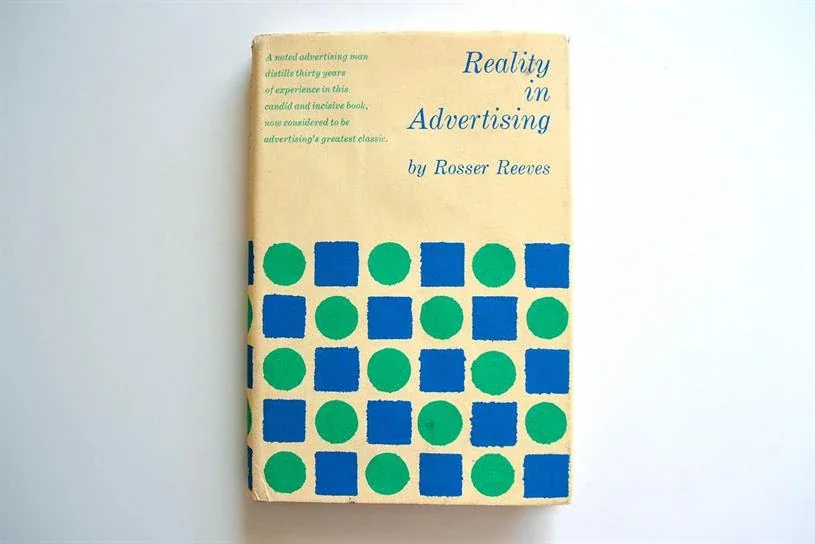
In 1961, Reeves introduced the theory and practice of UVP/USP in his book Reality in Advertising. It was then that this term entered mass consciousness. In his book, Reeves strongly demanded that advertising clearly communicate why the consumer should buy the advertised product rather than another. It is important that the company also delivers what the advertising promises. Otherwise, success will not be lasting.
Even though Rosser Reeves' aggressive ideas were no longer as effective in the 1960s, his UVP idea is still valid today.
In the 1970s, strategy was replaced by creativity. USP found a formidable rival in positioning, an idea developed by Al Ries and Jack Trout. The duo argued that consumers can only have a small number of brand associations in mind at a time. They said companies should therefore focus on positioning themselves - and if necessary, removing another brand so it can take its place.
So we can say that in the early 1980s USP collapsed, but it did not go out of circulation. The revival took place thanks to a change in advertising conventions - 30-second TV commercials were shortened to 15-second spots. Suddenly there was no time to subtly encourage people to buy. You had to go straight to the point and instead of building positioning, use USP again. A perfect example is the Energizer Bunny campaign, which showed the USP of the product, i.e. longer-lasting batteries. You can see the first ad in this series here:
UVP has returned to favor in the marketing world. Theodore Levitt, a professor at Harvard Business School, wrote in his book Marketing Imagination [1983]:
“Differentiation is one of the most important strategic and tactical activities in which companies must continually engage.”
In 2003, Philip Kotler suggested that USP should be replaced by ESP - the emotional selling proposition. Why? Finding a truly unique benefit is often impossible in a saturated market where even new products are quickly copied. Therefore, brands should focus on emotions instead of functions and build an emotional bond with consumers. This heralded the creation of Value Marketing, which is the basis for many brands today.
It can be said that the idea of UVP/USP has developed and evolved. The need for brands to stand out in a crowded marketplace by promoting specific benefits that competitors cannot or do not offer has never been greater. And you can stand out in millions of ways!
Sources:
1. www.millwardbrown.com/mb-global/brand-strategy/brand-equity/brandz/top-global-brands/2015 (accessed 21/01/2022)
2. www.zoneinwestorow.pl/artykuly/gaming/20220119/wishlisty-polski-rynek-gier (accessed 21/01/2022)
3. https://krytykapolityczna.pl/gospodarka/frugo-marketing-niszowy-i-produkcja-elastycznych-cial/ (accessed 21/01/2022)
4. www.slush.org/article/10-marketing-lessons-for-every-early-stage-founder (accessed 21/01/2022)
5. http://www.fundinguniverse.com/company-histories/bates-worldwide-inc-history(accessed 21/01/2022)
6. https://www.thedrum.com/opinion/2015/09/16/week-were-reading-reality-advertising-rosser-reeves (accessed 21/01/2022)