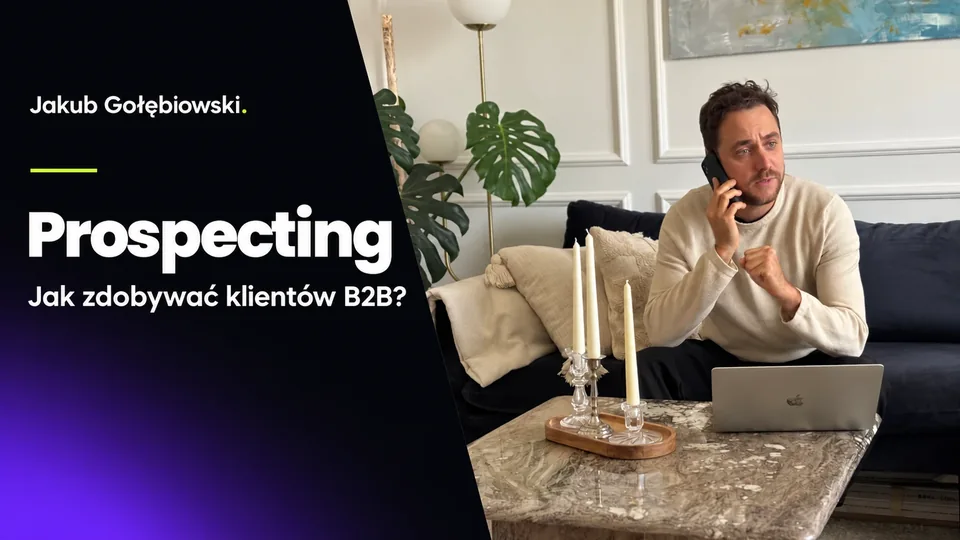
Prospecting, or how to acquire business customers in today's world?
When acquiring business (B2B) customers, prospecting is crucial - and has been for thousands of years. After all, the idea of "first find and then go to your client with the perfect offer and proposal" has been the basis of trade and doing business since forever!
Today we can do it faster, more efficiently and based on automation.
Below you will receive a practical guide: from personas and UVP, through message templates and follow-up sequences, to legal compliance and email deliverability.
🔹What is prospecting?
It's actively reaching out to people and companies who fit your ideal customer profile (ICP) but don't know you yet - via email, phone, LinkedIn, SMS
It comes from the English "prospect" - it's simply someone who meets the criteria of an ideal client who has not had contact with you.
🔹Where does prospecting work and where does it not?
▪️Where it works: B2B
Prospecting works with any type of B2B cooperation: both small companies and large corporations.
In corporations, to win large contracts, you need to have a brand and industry position - but even the largest organizations regularly buy smaller services from small companies. And this is our chance not only for now - it is often the first step towards larger contracts in the future.
▪️Where it works on average: in B2C.
The times of writing and calling (e.g. with photovoltaics) to random people are over - today it is a recipe for penalties.
At this point, Big Tech advertising systems (Facebook, Google, TikTok), SEO and building organic reach in social media work much better in B2C.
🔹What is the most important principle of prospecting?
The most important and unchanging principle of prospecting:
💡After reading your message, the recipient should think:
“Oh, this is exactly what I was looking for, it solves my problem, I want to know more!”
It doesn't matter whether new tools will appear in the future - this approach simply converts and brings results. To succeed here, you need to prepare the following elements:
🔹 How to prepare customer personas / profiles (ICP) for prospecting?
Creating personas is crucial in the prospecting process. We need to define and write down what specific solution we have for a specific type of client. Importantly, one that we can also earn as a company.
▪️How to create personas? Real knowledge is the basis.
Personas must result from our business model and market realities.
Regularly collect and update customer data: from marketing, sales, support and service. Combine them into one coherent picture (in accordance with the principles of knowledge management). It is very important that this information is real and true.
There are many patterns for creating personas, but the most important are:
Demographics: age, place of residence, gender.
Psychographics: personality, values, interests, motivations, lifestyle.
Professional situation: type and size of company, position, industry, etc.
Goals/needs: what is the real need of the organization and the individual.
Problems: what irritates, blocks, delays goals.
Decision-making process: who decides, how it happens and how long it takes.
Customer acquisition costs (CAC): How much does it cost us to acquire such a customer in total? We include the salesperson's work, marketing, prospecting tools, etc.
How much money will the customer leave with us? (LTV) How much money will such a client leave with us over the entire period of cooperation? Do we have subscription services, one-off services, annual contracts?
Return on investment (ROI) perspective: We subtract total customer value (LTV) from the cost of acquisition (CAC). Thanks to this, we know how much we earn for acquiring and servicing it.
💡 What's important - you don't have to force it all. If we don't know something, we don't enter it on a whim. It's better to have an empty space than to enter made-up information - which may later be duplicated by people in our organization.
▪️How many prospecting people should you have?
In many industries, 3-4 people are enough.
It happens that in companies with tens of millions of zlotys in turnover, there is only one.
💡The most important thing - it's not worth creating personas for the sake of creating personas. This is not a college assignment.
🔹 Creating and sending messages in prospecting
▪️Development of values
UVP (Unique Value Proposition) is a unique set of features of your brand that are valuable to the customer and are offered by no one else on the market.
A strong UVP is stronger than the most creative campaign - it is what causes people to choose your brand in a saturated market.
According to Millward Brown research, over 10 years:
with a similar scope of activities and marketing budget, brands with strong UVP grew by 168%, while those with weak UVP only grew by 27%.
brands with poor marketing activities still grew by 76% if they had good UVP
There is more about this in this article:https://www.jakubgolebiowski.pl/post/uvp-usp-unique-selling-proposition
▪️Development of the offer
Once we know our customers, it is worth preparing an offer for them with an ideal solution, but also told in their language. This is called mimicry.
A subtle reflection of the client's posture, gestures and language builds a sense of understanding. Research showed that waiters who repeated what guests said when ordering received higher tips. Retail salespeople achieved better conversions when they subtly adjusted the way they spoke and gestured.
It's not magic, it's a neurological signal: "he is like me and understands me."
▪️Shipping: 4 main approaches
Spray and pray – you sow widely and pray. This is a situation where we present the offer very broadly: we set large target groups and broad personas in prospecting tools. This is a poor strategy because anti-spam filters (today powered by AI) learn and analyze content quickly, so a large volume ends up in spam. In addition, the accuracy of the message decreases - the chance that the message will perfectly meet the recipient's needs is low. I don't recommend it.
No bullshit – straight to the point, proposal in the first message. In an e-mail, text message or on LinkedIn, we write briefly: what we deliver, what the business effect will be and whether the recipient wants to talk immediately. Often, 3-4 sentences are enough ("Hi, we're doing X. We'll help with Y. How about a quick chat?"). Many results-oriented decision-makers appreciate this because they do not have the time or inclination for small talk - this approach speeds up decisions and gives a quick "yes" or "no" answer.
Kissing – presence first, message later. First we follow on LinkedIn, comment and get associated, and only then we write a DM. This works in many industries, especially when the list of accounts is short, but it can be unscalable and time-consuming - so it's not for everyone.
Prospecting + marketing - the perfect duo. For me this is the optimal approach. First, we collect interest in content and campaigns (e.g. by directing people to the website), we catch purchasing signals, and then we contact these people in prospecting. Leads can be additionally "warmed up" with advertisements on LinkedIn and Facebook - precisely by positions and even specific companies. First, advertising builds awareness, then comes direct messaging.
▪️Operate omnichannel, i.e. send wherever and whenever possible.
Omnichannel is simply a multi-channel operation.
E-mail alone is not enough these days - it is just one of the elements. That's why we operate multi-channel in prospecting: e-mail, text messages, LinkedIn. We also make phone calls and then ask: "Hi, you received a message from me - I would like to talk about possible cooperation."
Generally, people have a very short attention span and there is no reason to expect that someone will be interested in our services after one text message or one e-mail. This is rare. Usually you need to remind yourself. The more meaningful reminders
the better. The better tailored to the customer's needs, the better.
▪️Follow-up, i.e. we are pushing ourselves to the end
One message is not enough. Good communication sequences are often 8-12 messages over a 21-30 day period.
Example:
Email (day 1)
LinkedIn + follow (day 2)
SMS/Whatsapp (day 4)
Email no. 2 (day 7)
Comment/reaction (day 10)
Telephone (day 14)
Email no. 3 (day 18)
Final follow-up (day 25)
Automations (e.g. Apollo, Woodpecker, Lemlist) will do it for you - but only if you have a well-defined customer profile and an efficiently implemented CRM.
▪️SPAM and email deliverability (must-have in 2025).
Nowadays, anti-spam filters are surprisingly smart, they have AI implemented and quickly detect repetitive messages. To improve this, it is worth considering:
Get technical about your domain configuration: SPF + DKIM + DMARC.
Add "one-click unsubscribe" in the headers (List-Unsubscribe + List-Unsubscribe-Post according to RFC 8058) - today required for mass senders via Gmail/Yahoo and enforced (requirements from 02-06.2024).
Limit the number of messages you send. Send only to those who really show promise.
Slowly increasing shipping. Launching a campaign on a fresh domain en masse is a recipe for a spam filter. The boxes look at: daily volume, growth rate, complaints, rebounds.
There are a few more tricks and I talk about them in more detail during prospecting training: www.jakubgolebiowski.pl/szkolenie-prospecting.
🔹What else is important in prospecting?
▪️Lead qualification
Qualification is a simple check of the client: whether we can help them and whether we can make money from it. Not everyone who has money is your customer. At the same time, the ideal client without money is also not promising.
Therefore, it is worth introducing even simple scoring (customer value assessment system).
The simplest example:
Scale 0–100:
Company Alignment (0-40) + Role (0-20) + Timing (0-20) + Intent Signals (0-20).
The threshold for sending an offer and starting work for a salesperson: ≥ 60, and the rest of the customers go to the database for the future.
Data from the National Court Register, financial data, number of employees, technologies used, and recruitment activity are helpful.
▪️Customer segmentation in prospecting
It's difficult to write a separate email and offer to each person, so it's worth segmenting. This allows you to scale personalization without writing 500 unique messages.
The most important thing in segmentation is to define specific target groups - people in business who will like our solution and from whom we can make money.
We divide it into groups. Then we write and prepare one type of content for one group, and another type of content for the other group. It is very important in segmentation to really respond to customers' needs and to ensure that the content is precisely written for their situation.
It's good to have a separate landing page, separate offers, separate marketing materials, separate automations.
This allows you to "surround" 500-1000 customers with the same offer and maximize your activities in relation to the time needed to produce results.
▪️Research on purchasing signals
These are signs that someone is looking for something - preferably services like yours. These are not only website entries, but also: funding, recruitment, staff changes, website technologies, lists of event participants, social media, etc. Many AI tools help detect such signals.
Where to look for such information?
KRS/CEIDG/GUS,
grants,
public procurement,
recruitment announcements,
personnel changes,
technologies on the website (Wappalyzer-like),
website visits (first-party),
lists of event participants.
participation in fairs
social media.
🔹What are the prospecting tools?
▪️CRM - an absolute must-have.
Without a decent CRM (segments, contact statuses, integrations), prospecting turns into chaos. A notebook or Excel wastes time and energy.
Any good CRM will do - it can be of global or Polish production, but it must be integrated with prospecting tools.
Usually this can be done automatically, many tools already integrate very beautifully and that's great, but sometimes you can also do it with Zapier.
▪️Popular solutions:
Apollo (large database; no native full omnichannel),
Sales Navigator (LinkedIn) - great in its ecosystem, but single-channel,
Woodpecker / Lemlist / Instantly - email sequences,
Clay / HubSpot / Pipedrive - data combining, scoring and CRM.
🔹Important: proof and materials!
Before you start prospecting, before you start sending information to people, it is worth preparing a template for them to make decisions.
Often, the people we write to do not make decisions. They have to take our offer further and ask the manager's superior and the board.
If we do not have a good website that serves as a basis for what we do, we do not have case studies, we do not have video materials explaining, for example, how our service works, how it can benefit and help our client, then even when we get a good lead, even when we give it to him and convince him, we will not give him the tools to go to his superiors and advertise us, he will simply sell us.
Many people nowadays, before making a decision in B2B, spend 70-80% of their time researching information on their own and only then contact us. We have to be ready for this.
🔹 Process and consistency are the key
Business is all about delayed gratification. What we do today translates into months and years ahead. What we don't do - too.
Think like this:
The hunters caught the game and immediately had food.
The farmer had to sow, take care of it, and wait for months for the result.
Who built our civilization? Farmers. It's the same in business - those who only think "here and now" usually don't build great things.
It's the same in sales: a message today may pay off in a month, a quarter or a year. It is important to be "on the radar" in times of need and decision.
▪️Pipeline math – how to think about prospecting as a system and an equation
There is no magic. Prospecting is a game based on statistics and discipline. It works something like this:
Example with 1000 contacts
The email opening rate is 40% = 400 contacts
The answer from this is 10% = 100 contacts
40% = 40 contacts will want to talk to us
80% = 32 contacts will want to get the offer
Will decide to cooperate and sign a contract 25% = 8 contacts
This means that in order to gain 8 customers with such results, you must have 1,000 well-selected contacts and a full cadence of messages.
Going further - if you want 80 customers, you need 10,000 contacts. This just illustrates the idea, in real life it is not that simple.
🔹 Is prospecting legal?
In short: usually not (without consent). I'm translating now.
Prospecting in Poland is generally illegal - after changes in the law, sending an unsolicited commercial offer to a natural person is generally prohibited. In the West, restrictions can be even stricter.
And now: what constitutes an “unsolicited commercial offer” is still fluid. There is no strong court case law in this respect. Still.
Gaining consent is often very difficult - and in effective prospecting, it is crucial to go beyond your own bubble of friends and clients.
But you can think about probability here.
For the law to even work, someone has to take the case to court. And for that to happen, you have to really piss someone off.
If we write to a person who is completely unrelated to our industry, without offering him any sensible solution, and the message is completely out of date, there is a good chance that the recipient will get angry enough to take it to court.
But let's look at it from the other side. If we have a specific solution for a given industry, well describing its problems, and we write: "Listen, I have something that can help you" - then the risk of dispute decreases. The likelihood that someone in our industry will decide to file a lawsuit is slim, but it still exists.
A simple example from real life: I live in a tenement house and salespeople keep calling me, asking if I want photovoltaics. I am neither decisive nor interested in it. Anyone else would get angry and go to court. I'm not at that stage yet. Still. But if someone doing photovoltaics is reading this - be careful 😀
▪️What are the penalties for bad prospecting?
Penalties are up to 3% of annual revenue or PLN 1,000,000.
▪️How to reduce the threat of penalty for prospecting?
The most important thing: the law is not one-size-fits-all and NONE of the following rules provide 100% security.
At the same time, basing your activities solely on them limits your effectiveness - the essence of prospecting is to reach beyond your own bubble.
Data publicly disclosed by the company. When a company publishes contacts for business purposes (website, industry directory), you can write without prior consent - provided that the message actually concerns the recipient's business profile. Example: contacting a purchasing specialist with a question about the market situation related to their industry.
Follow-up after industry events. If someone provided a business card or contact details at a fair, conference or meeting, contact is allowed "on topic", consistent with the context of the conversation. Remember about the information obligation and it is worth thanking for previous contact and asking about your willingness to continue in the first message.
General company addresses (e.g. "info@", "office@"). PKE and GDPR allow communication to mailboxes not assigned to a natural person. Such contact is generally not a direct advertisement to a private person, as long as the content is relevant to the company's activities.
Already existing relationship. You may communicate about products/services similar to those that were previously the subject of a transaction. Always provide a simple option to unsubscribe from further communications.
Legitimate interest in B2B relationships. A proposal for cooperation between companies that may bring mutual benefits (e.g. to the person responsible for purchases) is sometimes considered to be a legitimate interest - under certain conditions it is possible to establish contact without prior consent.
LinkedIn – the gray area. It's a platform with its own rules and community practices. Sending messages is sometimes tolerated, but does not formally replace the requirements arising from the provisions on electronic communications and data protection.
Transparency and information obligation. The purposes of processing contact data should be clearly indicated and the recipient should be informed about his rights (e.g. withdrawal of consent, deletion of data).
Easy discharge mechanism. Each marketing message should contain a clear and immediate way to unsubscribe. Not having this option increases the risk of complaints and deliverability issues.
▪️Legal basis for prospecting in Electronic Communication Law:
The provision of November 10, 2024 on the Electronic Communications Law (PKE) states clearly:
It is prohibited to use:
automatic calling systems,
telecommunications terminal devices, in particular as part of the use of interpersonal communication services for the purposes of sending commercial information within the meaning of the provisions of the Act of 18 July 2002 on the provision of electronic services (Journal of Laws of 2020, item 344 and of 2024, item 1222), including direct marketing, to the subscriber or end user, unless he has previously given his consent.
The consent referred to in section 1, may be expressed by the subscriber or end-user providing an electronic address identifying him or her within the meaning of the Act of 18 July 2002 on the provision of electronic services, in order to send commercial information to the electronic address provided by the subscriber or end-user.
Using the means referred to in section 1, for the transmission of commercial information, including direct marketing, cannot be done at the expense of the end user or subscriber.
The action referred to in section 1, constitutes an act of unfair competition within the meaning of the provisions of the Act of 16 April 1993 on combating unfair competition (Journal of Laws of 2022, item 1233).
🔹 Summary
Prospecting is a great tool, but it must be implemented wisely. Today - thanks to many tools available in the SaaS model, as well as thanks to AI - you can do it really well and cheaply.
It allows you to acquire great business customers at a low cost, so you can grow your business.
What I wish for both myself and you.