
You are good at what you do. You have several years of experience, clients praise your work, and you increasingly find yourself thinking: ‘I could do this on my own.’ So you start a business and build it around the skill you already have.
That is a perfectly natural starting point. I started in much the same way. The trouble begins when we assume that knowing how to do our work means we also know how to run a business that sells it. Only later do we realise how much we never saw, because someone else used to handle those responsibilities.
That is why an entrepreneur needs a generalist’s perspective and a view of the business as three essential foundations working together.
The three foundations of a business: product, sales and management
It is worth looking at your business through these three areas from the start. This is a useful simplification. It helps you see what is missing, instead of endlessly improving what you are already good at.
Your product is what the customer receives and pays for. It could be a service, a digital product or a physical object. What matters is whether customers need it, whether it solves their problem, and whether it delivers what you promised.
Sales, in this sense, covers everything that helps you reach customers and persuade them to buy. You need to know who you can help, how to reach those people, and how to get them to want to buy from you.
Management is the operational work that keeps the business running every day. It means using your resources in a way that lets you understand what you are doing, why you are doing it, and whether you could do it more efficiently.
Neglect one foundation and the others suffer
Any one of these areas can hold back the whole business. Some simple examples make this clear.
When sales fail
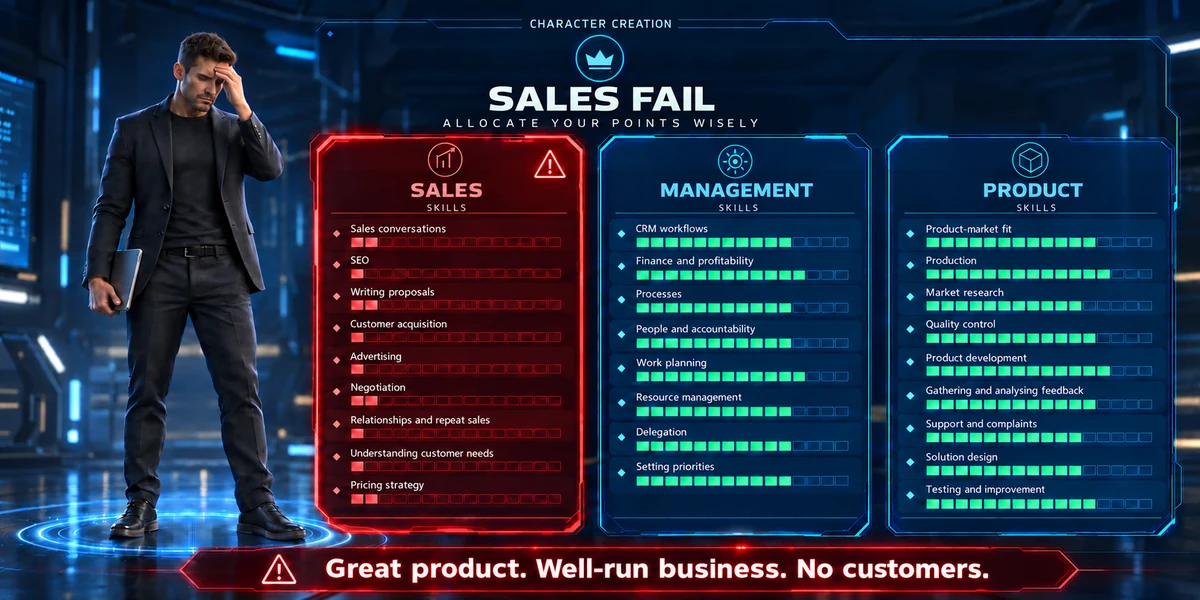
You have a great product and a well-organised business, but poor sales. You can deliver something valuable, but you have nobody to deliver it to. Your equipment sits idle, your calendar is empty, and you wonder why customers have not found you yet.
When management fails
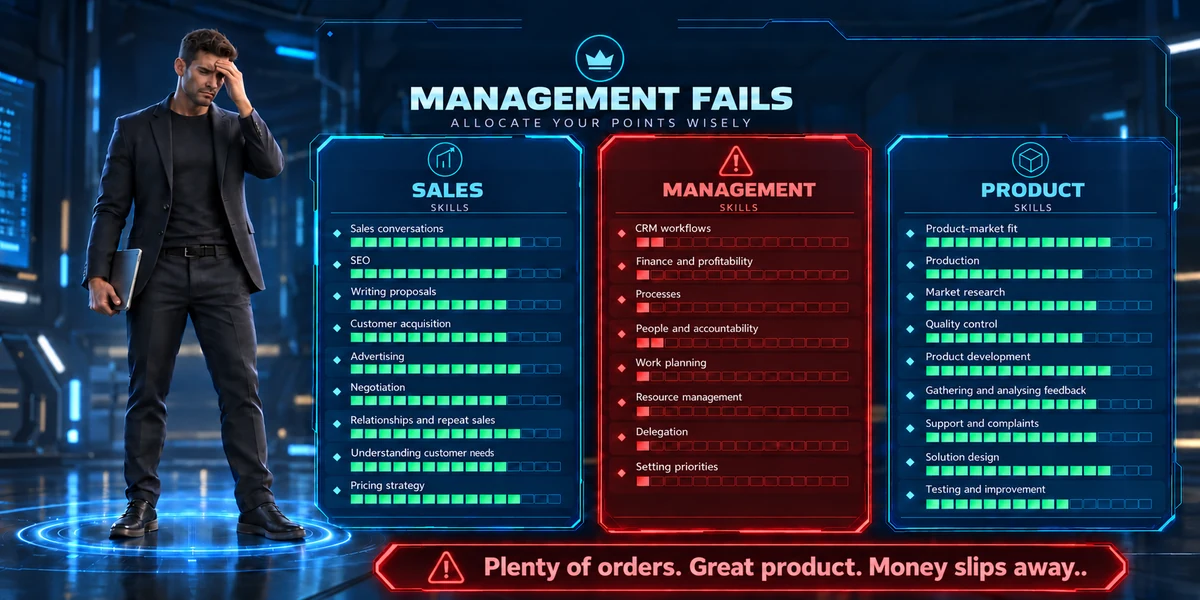
You have a great product and strong sales, but poor management. Orders keep coming in, everyone is busy, and the money somehow disappears. You go over budget, projects drag on, and nobody can work out who was supposed to take care of what. You can have plenty of work and very little profit to show for it.
When the product fails
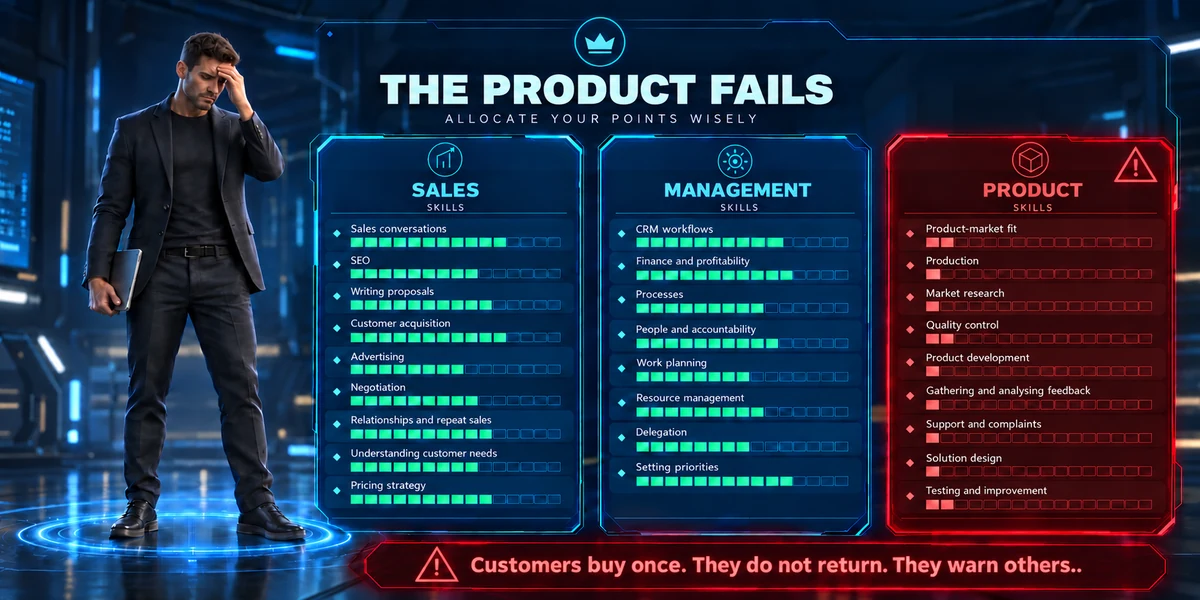
You have strong sales and efficient management, but a poor product. Customers buy because you know how to persuade them. Then they receive something that fails to meet their expectations. They do not come back, they warn their friends, and you have to keep finding new people who will still buy from you.
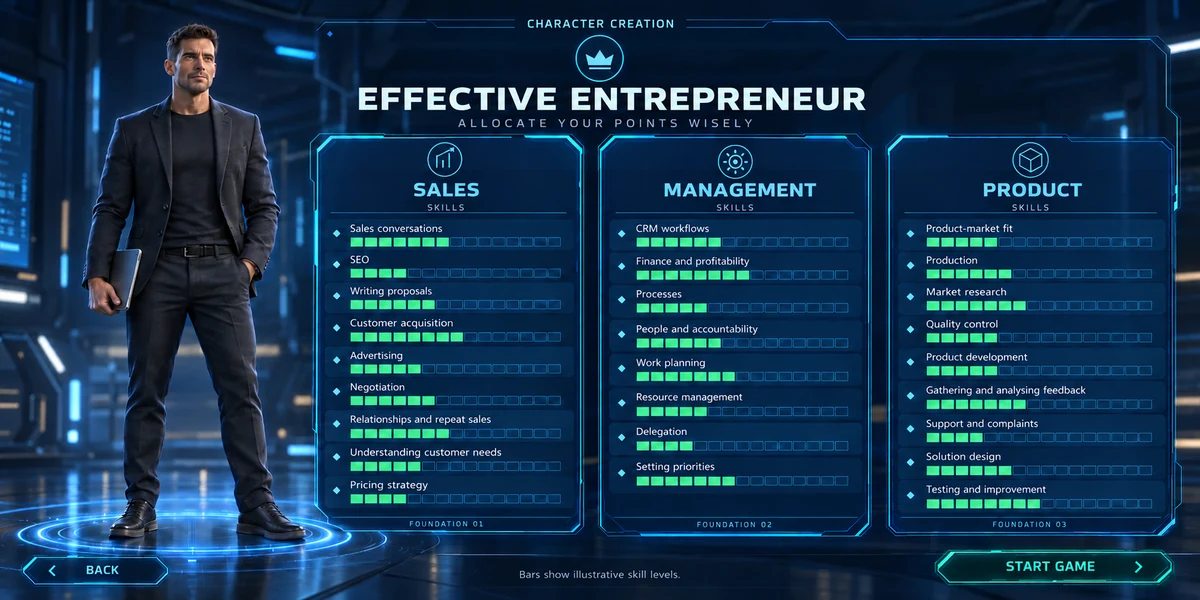
That is why being good enough across all three areas is much more useful than being outstanding in one while completely neglecting the others. A business needs to work as a whole. Another product improvement may change very little if the real problem is a lack of customers.
As an employee, it is easy to overlook the rest of the business
As a specialist in a larger organisation, you can spend years working on just a small part of its operations. That makes sense. Larger organisations need more specialised roles. Someone wins customers, someone agrees the terms, and someone follows up on payments. You receive a specific task and do it well.
From that position, it is easy to think your part matters most. You design the project, run the campaign or deliver the service. Everything else happens somewhere in the background.
Once you start your own business, all that other work suddenly lands on your desk. You need to win a project, agree its scope and make sure it makes financial sense to deliver it. When more work comes in, you also need to find help and organise things so you are not fixing everything late into the night.
The skills that made you a good employee still matter. You are simply responsible for much more now. This is often the hardest adjustment: you enjoy your specialism, while sales conversations or setting up processes feel like an unwelcome extra.
This can help explain why a new business struggles, or why its owner ends up with a worse working life than they had as an employee.
Stop trying to impress your industry peers
I built my first events business out of a passion for music. I was a musician, I was interested in equipment, and I made purchasing decisions through the eyes of an industry insider. I bought microphones whose quality I could appreciate. I considered equipment that would delight me as a sound engineer and impress other sound engineers.
Looking back, I can see that many of those decisions paid too little attention to the customer. What colleagues would say and what people recommended on forums seemed much more important.
Meanwhile, the customer usually does not care whether I turn up with a mixing desk worth PLN 10,000 or PLN 100,000. They care about the result of the whole service. They want the event to go well, the sound to be clear, and to get through the evening without worrying about the technical side.
Of course, some jobs require specific equipment. But you should be able to explain what the customer or the business gains from it. Does it let you handle different events? Does it make the work more efficient? If the only clear benefit is approval from other sound engineers, it is worth pausing.
It is easy to adopt the standards of the people around you. Someone buys new equipment, and suddenly you need it too. An hour ago you could do your job perfectly well. After reading a forum, you feel you cannot be a proper professional without another purchase.
Following the crowd can be expensive. Especially early on, when money spent impressing your peers could help you win customers or organise the work better.
An enthusiast can buy expensive equipment simply because they want it. I understand that pleasure very well. When spending the company’s money, though, it is worth being honest about how much of the decision serves the business and how much serves your own interests.
Work on the area you neglect most
There is another trap here. We prefer doing what we already know. A specialist will happily take another course in their field, improve their craft, buy a tool and refine a detail most customers will never notice. It feels familiar and satisfying.
It is much harder to sit down with something we struggle with. Call a potential customer. Work out why the last project left so little money. Establish a way of working and then stick to it.
Yet that may be where the biggest opportunity lies. If you have no customers, further refining your craft can be a comfortable way of avoiding the real issue. If your calendar is full but you are always short of money, it is worth looking at the terms you agree and how you deliver the work.
You do not have to know how to do everything yourself. You can find a business partner, get help or outsource some of the work. You still need a view of the whole business so you know what to pay attention to and how to tell whether it is working.
If you are just starting out, I suggest a simple habit: regularly look at sales, product and management separately. Ask which area is holding the business back today. And whether the things that fill your day actually help solve that problem.
I wish I had asked myself those questions earlier.
A final thought
Does this approach solve every problem? Absolutely not, but you might be surprised how much it can help. Whenever I advise a business, I start by looking for a gap in these three foundations. I usually find one.
When starting a business, it is easy to focus on what we already know and enjoy. But the business also needs the work we would rather put off. You can be excellent at your craft and stand still for years because you neglect sales or fail to control costs.
That is why it is worth regularly checking what holds your business back and directing your attention there. Sometimes you need to learn something; sometimes you need to hire someone better than you. Think of it as allocating points in a game. Another level in a skill you have already developed may change very little if neglecting the others keeps making you lose.
I wish I had understood this earlier. I would probably have owned a few fewer microphones and had a better-run business.