There are times in business and in life when things get really hard. You are building something from scratch or trying to get out of a difficult situation. There is a lot to do, everything needs attention, and you want to reach your goal.
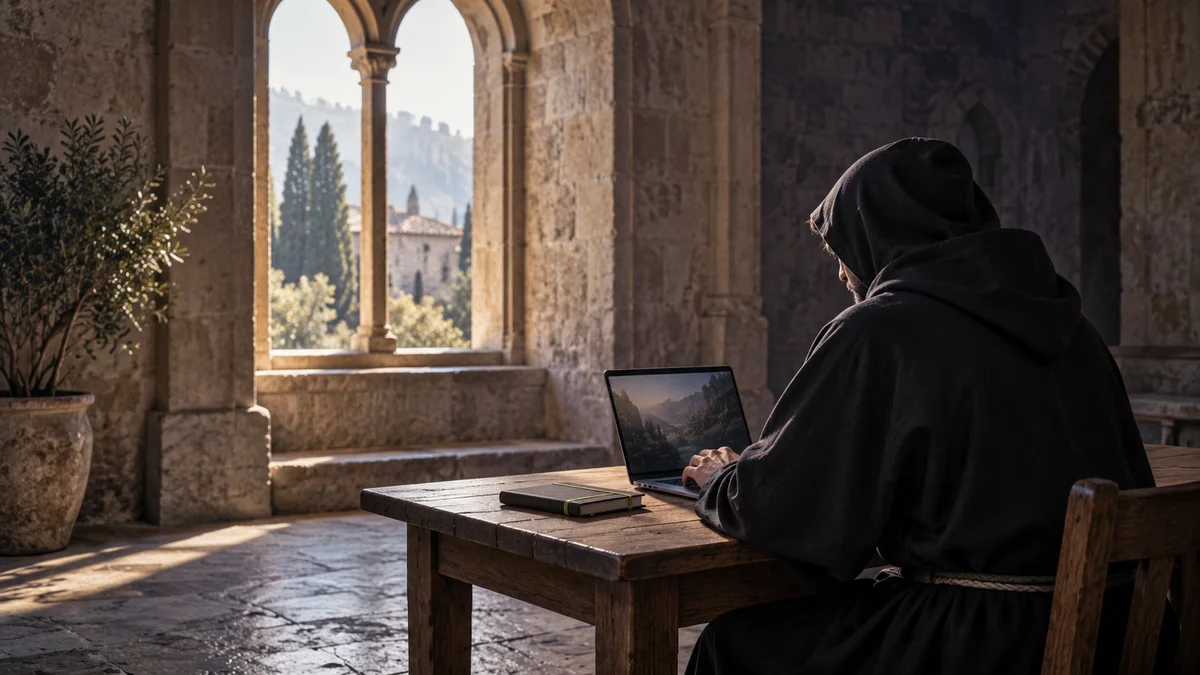
At times like these, a useful approach is something I call temporary monasticism.
It is a surprisingly simple and powerful idea that I have used several times in my life and that has helped me solve many problems. That is why I recommend it to people who are struggling or trying to do something that demands real concentration.
What do monks have to do with running a business?
Why were monasteries built far from cities, why did monks own almost nothing, and why did their daily lives follow inviolable rules? Because when you want to do difficult, important work, it is worth removing everything unrelated to that work.
When you reduce distractions, your mind can focus on the activities that remain. And if those activities contribute to your success, you stand a much better chance of achieving it. Simple in theory, surprisingly difficult in practice.
So…
Running a business? Make yourself a monk, for a while!
When I want to do something big, I tell myself: right, for a while I am going to be a monk. I focus on what I want to accomplish now and cut back on the rest. For a time, there will be fewer TV shows, games and nights out, fewer attractions, less shopping and fewer holidays.
Unlike monks, I do this temporarily rather than for life. I have something very specific in mind: let us get through this work, finish the important things, and then enjoy the results.
Knowing that it is temporary makes a big difference. It is easier to give something up for a particular phase than to ban it for life. As Nietzsche said:
“When you know why you live, you do not worry about how you live.”
(“When you have your own ‘why’ in life, you can endure almost any ‘how’.” (“Hat man sein warum? des Lebens, so verträgt man sich fast mit jedem wie?”)
Difficulty 1: Our entertainment can be surprisingly tiring
Here is where it gets difficult. When people work hard, they want to reward themselves. Especially in the way promoted by marketing agencies: through consumption. Yet that way of unwinding can get in the way instead of helping:
- I finish work and start a game. What am I doing? Still solving tasks. I plan, make decisions and respond to problems.
- Watching things is engaging too. A TV series draws you into more stories. Scrolling TikTok gives us a new subject and a different emotion every few moments.
- The same can happen with holidays. I have too much on my plate, so I want to go away. But first I have to choose a destination, compare accommodation and organise the trip. Before I know it, I have another project to manage.
That is why temporary monasticism also involves cutting back on things that many people treat as a reward after work. It is worth looking at them critically, choosing what helps in your current situation and skipping what makes you more tired or distracted.
Difficulty 2: Our entertainment takes a surprising amount of time
Today we have so many engaging ways to spend our time that we often fail to notice how much they take. Fifteen minutes becomes an hour, and after a few weeks it is hard to say how many evenings have disappeared like that.
“Some moments are torn from us, others stolen quietly, and others simply slip through our fingers. The worst loss, however, comes from neglect. If you look closely, you will see that a great part of life passes in doing wrong, the greatest in doing nothing, and all of life in doing something other than what we should.” [Seneca]
Watching a season of a TV series can take thirty hours. That is a substantial amount of time in which you could do a great deal of work. In that context, putting the series aside stops looking like such a big sacrifice.
Everyone’s life is “the circulation of limited resources that have alternative uses”. (This is how the economist Lionel Robbins described the economy, but it also applies to everyone’s life.) If you spend hours on one activity, you cannot spend them on another. You have to choose. And making no decision is a decision too, but the worst one.
That is why it is worth first looking at small, recurring activities. Some take up a lot of time without being essential to my happiness or my relationships with the people close to me. That is often where extra time can be found without major consequences for family or other people.
Learn to enjoy boredom and let go of FOMO
We leave ourselves very little room for boredom. We try to fill every spare moment. Even rest can easily turn into a search for the next activity. Something has to happen; we have to watch something or be somewhere.
You cannot always have your cake and eat it. If I want to do something demanding, I have to accept missing out on other things for a while. During periods of intense work, we need time away from screens. A walk without immediately putting something on to listen to. A chance for nothing in particular to happen. I can have a free evening without filling all of it.
During a period of focus, getting enough sleep or going for a bike ride can be a better choice. It is worth taking good care of the energy we need for the work we have planned.
Your brain has limits
Why does monasticism work so well? Because we put our brains through a lot every day.
Our minds readily jump between different matters, and our attention does not always follow what is most important. A small issue can occupy us just as much as a big one, even if little depends on it. That is why reducing the number of activities also means reducing the number of decisions you make each day.
In the study “The Mere Urgency Effect” (2018), participants were more likely to choose tasks with lower rewards over tasks with higher rewards when the former appeared urgent, even if that urgency was illusory. Time pressure alone could therefore outweigh the greater benefit of a task.
Two experiments reported in 2009 showed that after moving from an unfinished task to another task, some attention remained on the previous one, impairing performance on the new task.
During his presidency, Barack Obama said that he wore only grey or blue suits to reduce everyday choices. He explained that he had too many other decisions to make to spend more time deciding what to eat or wear. In this way, he simplified his routine and saved his energy for matters he considered important.
It makes sense:
- When you are bored, you find solutions.
- When your day follows a steady pattern, focusing is easier.
- Stepping away from excessive stimulation means fewer opportunities to keep jumping from one subject to another.
I am doing it right now
As I write this article, I am halfway through a period like this.
I have put my company, Rek House, on a new course, I am building a new e-commerce business, and I have also released an album and recorded a lot of music. I knew in advance how much work all of this would involve and how demanding the things I wanted to finish would be.
So I made a deliberate decision: this is the moment. I am cutting back on everything that does not contribute to success. Right now I want to accomplish big, difficult things. I have to choose where I put my time.
If I spend several hours gaming in the evening, those hours will not come back. Of course, I can decide that this is how I want to spend my evening. But I want to be honest about that choice. When a particular result matters a lot to me, I know what I need those hours for.
Deep satisfaction is better than a quick pleasure
Someone might ask: after a few days, do you not start missing all those pleasures? Usually I do not, because I feel good when I am focused like this.
I have a goal, a vision connected to it and dreams of my own. I know what this period is for. That makes cutting back on entertainment much easier. I can give something up and feel satisfied at the same time, because I know what it brings me closer to.
There is a deep sense of purpose in it. I am doing things that matter to me, and that gives me a lot of satisfaction. Short-lived pleasures simply pull me less strongly at that moment. My project occupies my mind, interests me, and I want to see what will come of it.
I understand life’s pleasures, but I do not need the same amount of them at every stage of life.
How do you plan a period like this?
I would start with a specific goal. What should exist at the end, and why does it matter to me? Then I would look at the work ahead. What needs solving, what obstacles are there, and roughly how much time do I need? I cannot predict everything, but I can at least estimate the scale of the undertaking.
Suppose I want to launch an online shop and expect two or three months of intensive work. For that period, I cut back on games and aimless phone use. I also decide how I am going to rest, so that the plan is sustainable.
It is worth defining when this phase ends. For example, when the shop launches, or on an agreed date when I will review what I have accomplished. Then I can consciously decide what comes next. Without a boundary like that, it is easy to keep finding another reason to put the rest of life off a little longer.
I explain to the people close to me what I am working on and why I will be less available for a while. In my situation, that conversation works: people know what is happening. I also prefer to recover time from my phone and games before cutting back on meeting people I care about.
What if I start a game anyway?
It happens. I might also catch myself watching nonsense on YouTube for longer than I intended. Then I want to notice it and stop before a short break becomes an entire evening. One slip does not undo the whole plan.
I sometimes call it giving myself a mental tap on the wrist. I tell myself: “Kuba, you are being drawn towards that game again. You know what you want to do right now. That is enough for today.”
It is the familiar process of developing habits, and habits become second nature. Best of all, it gets easier. At first I have to pause more often and remind myself what I decided. Later, I spend less time negotiating with myself about whether to play today after all. I have already decided what this period is for, and organising my day around that becomes easier.
It also helps to remind myself each morning what matters now and what I am not doing today. I want it clear in my head. In the evening, when another temptation comes along, I can return to my decision. I know I made it for a reason.
Examples from real life
Red Hot Chili Peppers: a world of their own while recording
In 1991, Red Hot Chili Peppers recorded Blood Sugar Sex Magik, their fifth studio album. Instead of a traditional studio, they and Rick Rubin chose a house in Laurel Canyon, Los Angeles. Kiedis recalled that they rarely left, while Flea described it as a chance to play without the weight of everyday responsibilities. Even during preparations for the album, Frusciante had cut back on going to clubs and focused on creating. The recording process is shown in a documentary called… Funky Monks.
Bill Gates: seven days without email
Bill Gates has described his “Think Weeks”, when he would go to a cabin on Hood Canal with books and technical papers. For seven days, he read, thought and wrote about the future. He limited contact to the person delivering meals and did not even check his email. He deliberately set aside time to put everyday matters on hold and consider subjects that required sustained thought.
Bon Iver: three months in a cabin in the woods
Justin Vernon, the musician behind Bon Iver, spent three months alone in a cabin in the Wisconsin woods. Initially, he wanted to retreat after the breakup of his previous band. A simple routine, quiet and chopping wood gradually gave way to intensive recording. The material for For Emma, Forever Ago emerged from that period. This example also illustrates the point about boredom: leaving yourself some space can help you return to creating, even without a ready-made plan at the start.
Maya Angelou: a few hours a day in an empty room
Maya Angelou told The Paris Review that she would rent a hotel room for several months and arrive around 6.30 in the morning to write. She asked for decorations to be removed from the walls. She worked until midday or early afternoon, then returned home. Her concentration had clear boundaries: a fixed place and set hours, after which she returned to the rest of her life.