No matter what you sell, building sales funnels is the surest way to steadily acquire customers. Why? Because it is a universal system based on the human psyche and has been bringing results since 1904*!
From the article below you will learn in 10 minutes:
🔹 What are sales funnels and why are they called funnels?
🔹 Why do sales funnels work?
🔹 What are the basic funnels?
🔹 What are advanced funnels?
🔹 How to design and use sales funnels in practice?
🔹 How to measure your sales funnels?
🔹 What are the biggest mistakes when using sales funnels?
🔹 For the curious: Who invented funnels, or really sales pots?
I wrote this article for someone who has never encountered this issue, so it is full of really powerful simplifications. I wrote it so that my Grandma could understand it 😃. Therefore, if you work in marketing and already follow funnels, I recommend skipping reading.
You can also watch the video below:
What are sales funnels and why are they called funnels?
In one sentence:
It is a system of sequencing advertising activities so that they create an effective and repeatable process of convincing customers to make a purchase.
Why are they called funnels?
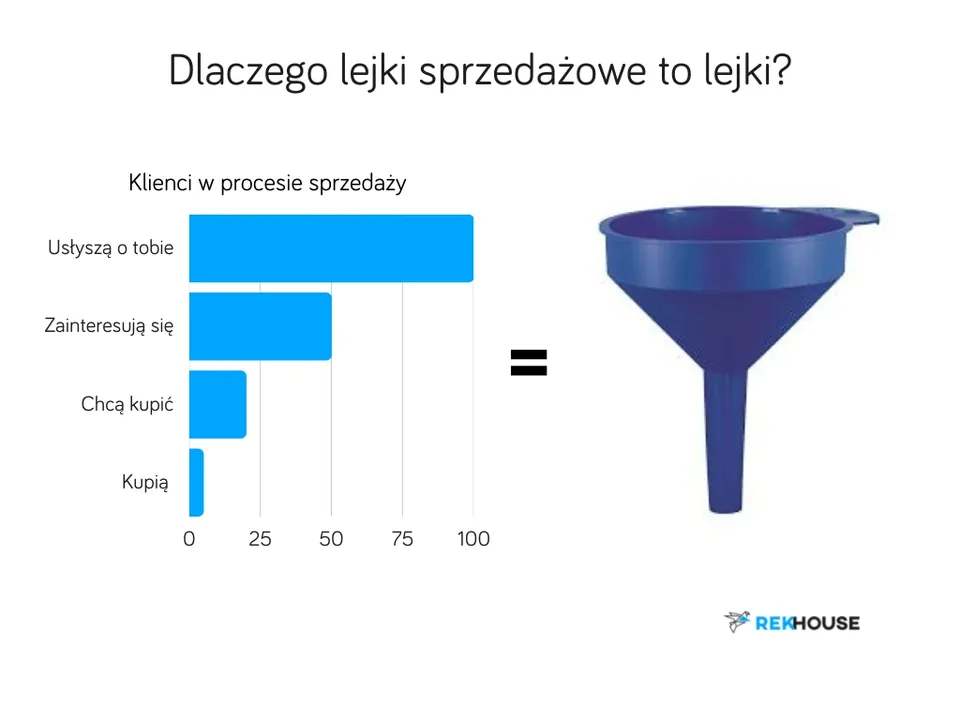
Because data tends to look like a funnel with more pouring into it than coming out at the end. At every stage, many potential customers will drop out. And that's how it should be, it's normal. To simplify:
100 people will hear about your brand -> 50 will be interested -> 20 will want to buy -> 5 will buy
This is shown in the image below.
It is worth drawing one conclusion now:
If you conduct your sales activities for a long time and examine your funnels well, you are able to predict the effects of your next advertising activities.
To simplify: to have 10x more customers at the end, you need to work 10x harder at each stage:
100 people will hear about your brand -> 50 will be interested -> 20 will want to buy -> 5 will buy
1000 people will hear about your brand -> 500 will be interested -> 200 will want to buy -> 50 will buy
Why do sales funnels work?
In a saturated and competitive market, most purchasing decisions follow a similar pattern.
The customer must be exposed to the brand in an appropriate way (sometimes 10 times, sometimes 20) to be convinced to make a purchase. It's not worth communicating immediately "Hello, I have this product, buy it from me here and now!" because it simply doesn't work. And even if it works, it will be for a very short time and in a moment you will be left without any new customers. People love to buy, but they hate being sold to them. Do you know someone who likes to be persuaded quickly and forcefully?
Persuasion to buy takes time, and you have to guide them to it like a lighthouse guides a ship to port. The customer should be in control. Feel in control and decisiveness. He is then convinced that he is making this decision alone. There is a Polish word that is inelegant, but it perfectly reflects the idea: you need to deal with the client skillfully to work, otherwise it will get scared.
How to do it?
This is where sales funnels come in handy. This idea was apparently created by the psychologist William James already... in the 19th century, but it has not become outdated at all and will probably be relevant for hundreds, or perhaps even thousands of years. It's just how our brains work.
What are the basic funnels?
Most sales follow the same pattern, during which the customer matures to make a purchase decision. It doesn't matter what it is: a car, a cinema ticket, cosmetics, a sailing course, a guitar or clothes. All this takes time and surprisingly repetitive steps:
the customer needs to learn about the product
take an interest in him
see the benefit in it and start wanting to own it
buy
The above steps are the basic sales funnels that are included in the name of the opera Aida. This abbreviation was proposed already in 1921 by C.P. Russell, but the S was quickly added to the Aida and it is the standard model still in use today.
Attention: Pay attention and try to let as many potential customers as possible hear about your brand. Don't sell anything. Just communicate loudly that you exist.
Interest / Interest: Get people from the above group interested in your product or service. Explain how it works, what functions and benefits it has.
Desire/Desire: Arouse desire among the above group for your product or service. Show the customer how it will improve their life and what they will gain.
Action / Action: Only now take the action that will lead to sales here and now. You need to change the customer's "maybe I'll buy it" into "I'm buying it now." Maybe some short and limited promotion?
Satisfaction / Satisfaction: Try to make the customer feel satisfied with the purchase, want to buy again and recommend to friends. Maybe a discount for the future, a good warranty, a loyalty card?
Let's take an example of buying based on AIDAs:
Attention: You are a motorcyclist. While at a motorcycle fair, you saw a new BMW model. It was so exposed that it immediately attracted attention from a distance.
Interest / Interest: You started reading about him on the Internet, watching videos on YouTube, and joined a Facebook group centered around the model. The reviews were very favorable and the films were inspiring.
Desire/Desire: You made an easy and pleasant appointment at the dealer for a test ride, after which you felt that you really wanted this motorcycle. After the test drive, the dealer asked to contact you
Action / Action: After a month, the dealer called you with information that there was a short promotion for this model and it was worth buying it as soon as possible - which you did.
Satisfaction / Satisfaction: The dealer added accessories to the motorcycle, a promotion for service and invited you to a rally he is organizing. You felt very satisfied with your purchase, you left a review on Google and a few forums, and you told other motorcyclists about it.
This is a really trivial sales process, but imagine if it would be a success if at least one element were removed from it? If a dealer called you right away after the fair, would you buy it? Without reviews and easily available information on the Internet, would you deepen your interest and belief in the model? If arranging a test drive was difficult, wouldn't you get discouraged? Would you delay your purchase decision without a time-limited promotion?
Removing or missing any step drastically reduces your chance of making a sale!
What are advanced funnels?
In today's marketing, more advanced sales funnels are often used - but in fact it is either dividing the AIDAs model into smaller steps or developing it to suit a given company's business model.
For example: a funnel called evaluation is often added between desire and purchase. This means the moment when the customer is convinced to make a purchase, but he can do it with a competitor. We should then take actions to make us look better compared to the competition.
Another example: in fitness clubs, retention, i.e. the number of returning customers, is very important. So what if you sell a hundred season tickets in January if most customers cancel them in March? The retention funnel includes activities that are intended to reduce this negative phenomenon.
How to design and use sales funnels in practice?
When designing sales funnels, it is worth creating a Customer Journey right away. At Rek House we usually use a table that looks like this (click to enlarge):
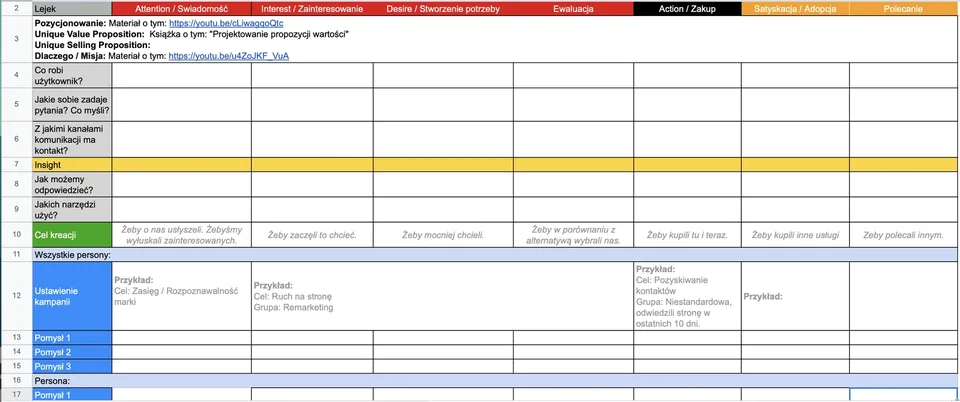
The columns in the table are funnels, and the rows are individual activities and ideas. Thanks to this, we have the entire advertising campaign on one card. On lines 2 - 5 we describe the brand, on lines 5 - 11 we describe the client and the rest are ideas for individual activities.
Insight is a suspicion of a customer's behavior or statements. They can come from anywhere: from forums or groups, opinions on the Internet, conversations, observations.
Example: The waiter in your restaurant heard from customers that your pizza is delicious, but the most expensive in town. It is worth entering such a thought in the "Insight" line in the "Evaluation" column to prepare a response for customers - for example, informing them about the highest quality of your ingredients, which justifies the price. At Rek House, we go a little further and I can't imagine creating a customer journey and planning a campaign without additionally:
- strategic assumptions - developed Value Proposition Canvas - specific brand positioning - specific communication language - written business model - precisely created ad creative - specific personas and target groups - precise budgets - constant iteration - precise KPIs
But these are topics for completely different articles that you will find by clicking here.
Remarketing
Ok, you've already prepared the customer's purchasing journey, but how do you know what to communicate, when and to whom? How do you know which client is at which stage?
A great tool comes to the rescue: remarketing. This involves displaying messages to people who have already had contact with the brand - they visited the website, liked the fan page, bought something in the store. This allows you to display separate messages to customers at different levels of engagement with your brand.
Example: It is not worth advertising a loyalty card to a completely new customer. But if someone already buys from your store regularly, then absolutely.
Such systems are created using, for example, Facebook's Ads Manager or the Google advertising system. Do you remember a situation when you visited a website and then ads for that product "chased" you around the Internet? This is what remarketing is all about. Thanks to it, you can lead your customers effectively
Creating such systems unfortunately requires the cooperation of a programmer and advertising specialists, or simply a marketing agency.
How long does it take to implement sales funnels?
We come to the most difficult step for many - patience and perseverance. Patience is the power on which our civilization was built. You can hunt animals and eat them right away, but you can also plant seeds and wait for them to mature and sprout. Tribes of hunters were quickly rewarded for their efforts, but it was farmers who built cities and states. That's what he's famous for Marshmallow test, which one even cuttlefish pass. It's the same in business. Sometimes you need to wait several months to develop full sales funnels and reap the benefits. This is called "lead warming" in the industry. A cold customer is one who has never heard of you - a hot customer is one who is almost convinced to make a purchase. According to research, an average customer needs to meet a brand on average 8 times to buy something. He won't do it in a week. Trust and awareness take a long time to build. The customer will not always have the need to purchase our product immediately. But if you implement funnels well, when a customer needs a service like yours, they will come to you.
At Rek House, we always strive to give quality services to our customers and plant seeds. It sometimes happens that after presenting our offer, the client does not immediately decide to cooperate. For various reasons - lack of budget, great need, other priorities. Then we don't force persuasion, we just do our thing and wait. We usually end up with good results.
On the day of writing this article, I received a call from a client to whom I presented the offer a year ago. The client started the conversation with the words "Mr. Kubo, we won't be able to do it without you. We are determined to fully cooperate" In this case, the purchasing process lasted 12 months.
The most important thing is to keep working.
How to measure your sales funnels?
“If you don't measure something, you can't improve it”
Peter Drucker, management guru.
Measuring your actions is as important as inventing and implementing them. Hard data will separate what we think from what really is. This will help you make better decisions and eliminate unnecessary actions.
Funnels are measured using KPIs, i.e. Key Performance Indicators. In Polish it means Key Performance Indicators. It sounds scary, but it's very simple - for each funnel, it is worth adopting an indicator that best reflects whether the activities bring benefits. If you create awareness activities, look at the reach. If you are creating an evaluation funnel, it is worth measuring how many customers come to you and how many to your competitors, etc.
You can create KPIs yourself according to your needs, but there are also a lot of materials on this topic where you can get inspiration.
What are the biggest mistakes when using sales funnels?
I have listed most of the errors above, so I will just summarize them quickly.
- Focusing on one stage of the funnel. This is a standard mistake of novice marketers and entrepreneurs. It is not enough to click "Boost Post" or cover the entire city with posters if you do not have a planned and implemented further path for the customer. The fact that a customer learns about your brand is not enough to convince him to make a purchase. The same thing works the other way around: if you focus only on closing sales and neglect looking for new customers, you can quickly take advantage of their purchasing opportunities and be left with nothing.
- No remarketing activities. In today's overstimulated world, customers will quickly forget about even the largest advertising campaign, so it is very important to remind those who already know the brand. It used to be very difficult, but today's Digital Marketing tools give even the smallest company greater opportunities than global brands used to have. Connect the advertising systems of social media portals and Google, and then set up remarketing properly.
- Lack of coherent strategy and communication throughout the sales system. If your ads say one thing and your customer service says another, you may alienate your customers. Worse still, it can create a bottleneck that will regularly waste all the work and money put into marketing. So what if a lot of tourists want to eat at your elegant restaurant because of Facebook ads if the interior design turns them off? Therefore, it is very important to have a coherent strategy and communication at literally every point of contact between the customer and the brand. Both in the digital and real world.
- Lack of analytics at every stage. Only by constantly measuring sales stages and analyzing the results will you notice problems and opportunities for improvement.
- Lack of patience. It doesn't take a week to implement the sales process, much less reap its fruits. If you want to run a healthy business and marketing, think of it as a marathon, not a sprint. Good luck!
Expand your knowledge:
- Marketing indicators, Robert Kozielski. The best collection of KPI inspirations on the Polish market.
- The Big Book of Ads from the Tigers Agency. An excellent book that will help you learn the secrets of advertising on Facebook without unnecessary fuss.
For the curious:
Who invented funnels, or really sales pots? *Even though most sources cite Elias St. as the creator and popularizer of the idea of funnels. Elmo Lewis, there is no clear proof of this. But this idea certainly appeared in Salesman magazine from 1904 and was illustrated with this drawing:
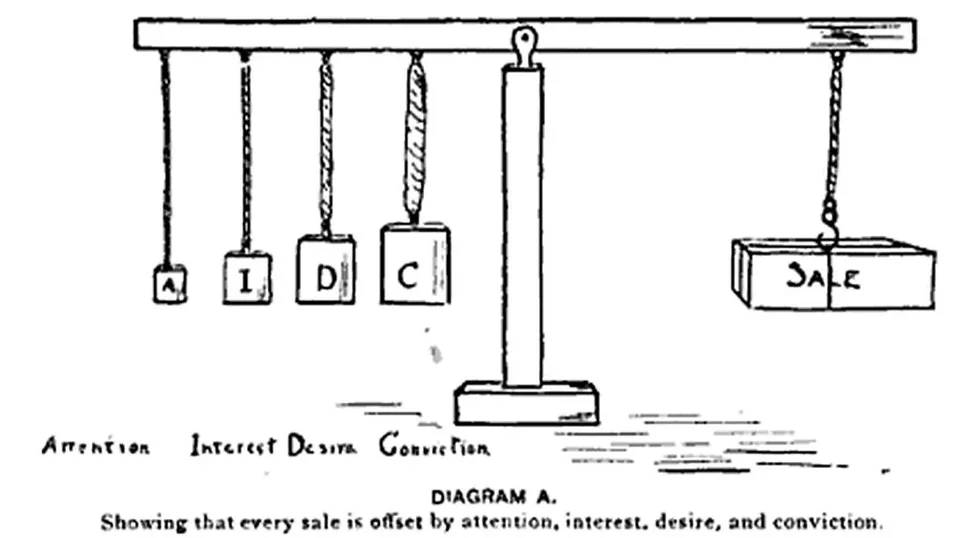
A fragment of an article that is as relevant today as the day it was published:
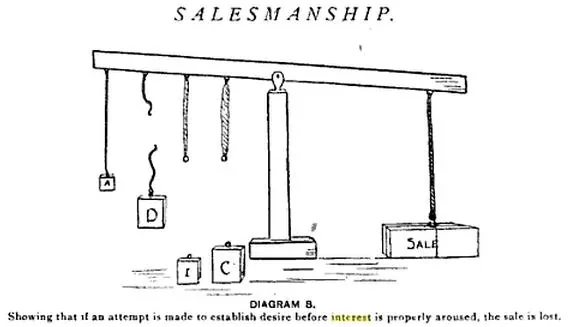
“Selling of any kind has four essential parts: attention, interest, desire and belief. Use them in the correct order. Don't confuse polite attention with interest, and don't assume that when the desire for possession occurs, conviction has been achieved. You will lose customers because of this, and it will be just as disastrous as not closing the sale once you are convinced.”
The figure below illustrates this well:
The next interesting fragments from 1904:You should not assume that every sale will be completed in one, two or three steps because many of them will be lost. However, understanding the science of selling, with proper practice, will tend to reduce the number of lost sales. It works like medicine: it doesn't completely eliminate diseases, but it reduces the havoc they wreak.”
Interestingly, at that time we weren't talking about sales funnels, but rather... about pots. “
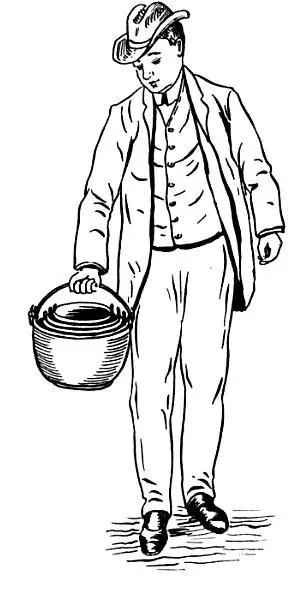
To further illustrate the principle of the four sales steps, we can consider the arrangement of four iron vessels as sales representations. We assume that the seller would not be able to carry these four pots separately and that they must pack them compactly to be able to move them. There is only one way in which pots can be assembled properly, and that is by placing a smaller one inside the largest one, and so on, so that they all take up less space and can be easily carried. The pots should be placed one inside the other in the correct order, taking one size smaller for each operation; otherwise, one of the two intermediate sizes is omitted because they cannot all be packed except in the normal order. You can't close a sale by ignoring the interest factor, nor can you convince and close the sale until the customer has reached the desire stage.”
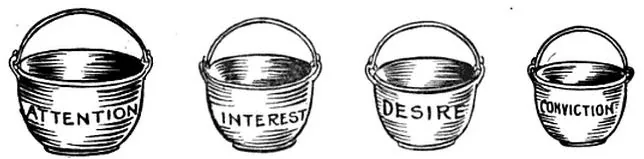
In 1907 A.F. Sheldon expanded the idea with a fifth element - lasting customer satisfaction after purchase. The first published use of the acronym AIDA dates back to 1921 in the article "How to Write a Letter That Will Sell" by C.P. Russell:
“An easy way to remember this formula is to refer to the 'law of association,' which is an old proven memory aid. Note that when you read down, the first letters of these words spell out the opera "Aida." When you start a letter, say to yourself "Aida" and you won't go far wrong, at least as to the form of your letter."
The idea of a "customer funnel", "marketing funnel", or "sales funnel" combined with the AIDA concept was first proposed in the book "Pharmaceutical Selling, detailing, and sales training" written by Arthur F. Peterson in 1959.